Daily Essential Oil Rituals: Meridian Massage & TCM Practice
Professional daily essential oil rituals—mIFPA certified practices for meridian massage, face oils, and TCM applications. Build your personal practice.

The following practices follow IFPA professional standards and are based on 10+ years of personal practice combined with professional training as an mIFPA certified aromatherapist.
The practice that holds everything together
There is a difference between knowing about essential oils and having a practice with them. It is useful to understand which oil suits which season, which meridian, which pattern. But knowledge without daily practice is simply interesting information. It does not change the skin, the sleep, or the quality of the transition between the day and the night.
The practices in this article are the ones that become automatic. They are the rituals you simply do, in the same way you brush your teeth or wash your face. They require no particular moment and no more than five minutes at a time. Done consistently, they produce cumulative effects that no single therapeutic intervention can replicate.
Rather than waiting until you know the essential oils perfectly, I would encourage you to use them and feel what changes they bring. You are unique. Only you can speak of the effect of the practice on you.
Previous story
Face oil — the daily topical practice
Topical application is the most versatile and most sustaining method in daily practice. A diluted essential oil applied to the skin is absorbed into the bloodstream within 20 to 30 minutes, producing both a local effect on the body part where it is applied and a systemic effect, reaching the organ systems along the relevant meridians.
Method: 1% dilution, i.e. a maximum of 3 drops of essential oil per 10ml of carrier oil. Apply after cleansing to slightly damp skin. Follow the direction of lymphatic drainage -- outward across the cheeks, upward from the jaw, outward from the centre of the forehead. Do not skip the back of the ears and the back of the neck. In TCM these carry Gallbladder meridian points connected to the nervous system and sleep quality.
The carrier oil you choose matters as much as the essential oil it carries. Each carrier has its own therapeutic properties, its own affinity for different skin types, and its own TCM energetic character. If you have not read our Carrier Oil Guide yet, go back to the previous story.
The essential oils change with the season and with what the body is navigating. I choose my essential oils and carrier oils carefully to suit my skin condition at that particular moment. At an age over 40, 2 bottles of facial oil made entirely from plant essences are my only daily skincare. For the oil recipes and how I apply them, see My Daily Rituals & Blend Recipes.
Hair and scalp care — the daily maintenance
The scalp has a dense blood supply and absorbs topically applied compounds efficiently. Essential oils relevant to scalp health work on circulation, the hair follicle environment, and the scalp microbiome. And washing your hair with a shampoo containing true essential oils is an entirely different experience from an artificially scented commercial product. The scent is real, the therapeutic effect is real, and the scalp knows the difference.
Method: add 2 to 3 drops of essential oil per 10ml of unscented shampoo base, or use as a pre-wash scalp treatment in a carrier oil base. Do not add essential oil directly to a commercial shampoo with a full formulation. The essential oils may interact with other active ingredients.
Popular oil recipies:
Scalp circulation and hair follicle stimulation: rosemary or peppermint
Dryness or flaking: cedarwood
Hair fall: lavender
The 12 meridians — an introduction
Massage with an essential oil blend is the application that most directly bridges Western aromatherapy and TCM practice. The hands moving along the body's surface follow the same pathways the meridians trace, and the oils carried by those hands reach the organ systems those meridians govern.
In TCM, Qi flows in a continuous cycle through the 12 primary meridians in the same canonical direction. The direction of massage matters.
Massaging in the direction of the flow is tonifying — 補 (bǔ). It strengthens and supports Qi where it is deficient.
Massaging against the direction of flow is sedating — 瀉 (xiè). It clears and disperses where Qi is stagnant or in excess.
For a daily home practice, follow the canonical flow directions below. They support harmonious circulation without the risk of inadvertently depleting what needs building or stimulating what needs settling.
The 12 meridians move in 4 continuous sequences:
1) The arm Yin meridians — 手三陰經 (shǒu sān yīn jīng) — from chest to hand
The Lung — 肺 (fèi), Pericardium — 心包經 (xīn bāo jīng), and Heart meridians — 心 (xīn) — originate in the chest and travel downward along the inner surface of the arm to the fingertips. Use this direction to support the Heart and Lung for respiratory support in autumn, for emotional calming in summer, for the nourishment of the upper body's Yin energy.
2) The arm Yang meridians — 手三陽經 (shǒu sān yáng jīng) — from hand to head
The Large Intestine — 大腸經 (dà cháng jīng), Triple Warmer — 三焦經 (sān jiāo jīng), and Small Intestine meridians — 小腸經 (xiǎo cháng jīng) — begin at the fingertips and travel upward along the outer surface of the arm to the shoulders, neck, and face. These meridians support the body's releasing and processing functions — the Small Intestine's clearance of body heat, the Large Intestine's capacity to let go, and the Triple Warmer's regulation of warmth distribution through the body.
3) The leg Yang meridians — 足三陽經 (zú sān yáng jīng) — from head to foot
The Stomach — 胃經 (wèi jīng), Gallbladder — 膽經 (dǎn jīng), and Bladder meridians — 膀胱經 (páng guāng jīng) — begin at the face and head and travel downward along the front, sides, and back of the body through the outer and posterior leg to the toes. The Bladder meridian runs in 2 parallel lines on either side of the spine, traveling vertically downward. These meridians support digestion and the processing of food, act as the body's defensive shield — 衛氣 (wèi qì) — against external cold, viruses, and illness, and govern decision-making, mental focus, and determination.
4) The leg Yin meridians — 足三陰經 (zú sān yīn jīng) — from foot to chest
The Spleen — 脾經 (pí jīng), Liver — 肝經 (gān jīng), and Kidney meridians — 腎經 (shèn jīng) — begin at the toes and inner foot and travel upward along the inner surface of the leg, through the inner knee, the inner thigh, and into the abdomen and chest. This sequence is the most directly relevant to women's health — the Liver, Spleen, and Kidney meridians together govern menstrual regularity, Blood production, hormonal balance, and the body's deepest reserves of Yin energy.
TCM-informed meridian massage
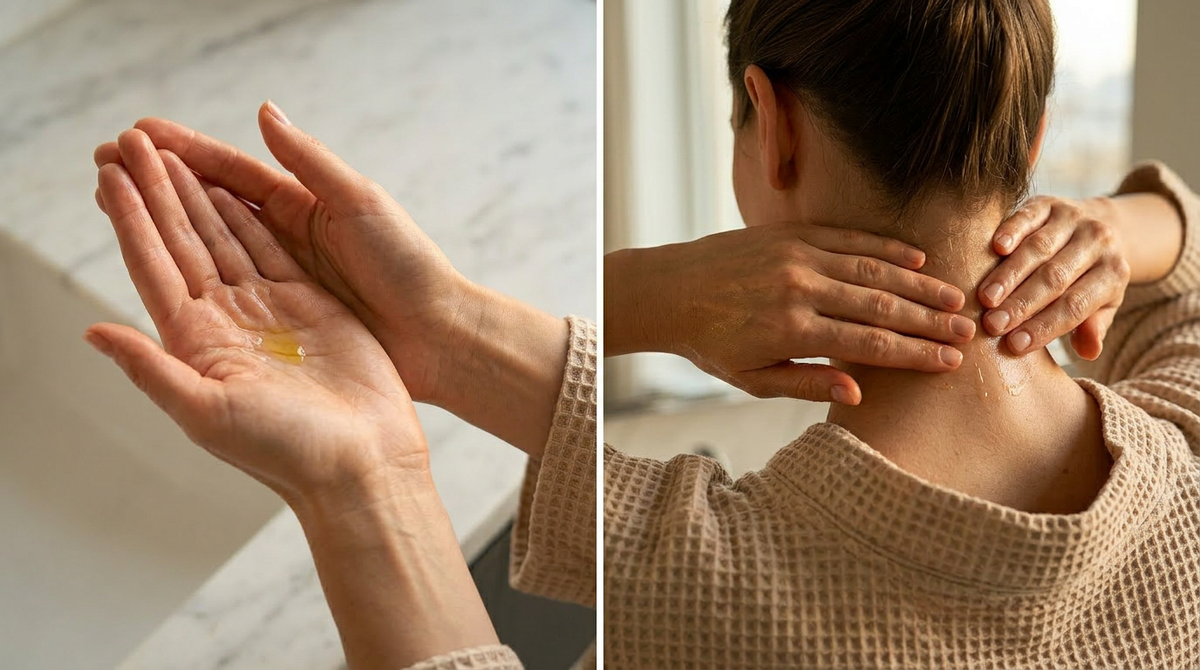
Warm the blend between your palms before applying. The act of warming releases the aromatic molecules into the immediate air, beginning the inhalation benefit simultaneously with the topical absorption. You receive the scent and the skin benefit at the same moment.
Let the hands move freely, but massage with intention on the legs and arms to nourish all 12 meridians. You do not need to remember their exact distribution. You only need to remember 2 principles:
Arms
Inner side — downward from shoulders to fingers.
Outer side — upward from fingers to shoulders.
Legs
Inner side — upward from toes to thighs.
Outer side — downward from thighs to toes.
Method: 1% dilution — a maximum of 3 drops of essential oil per 10ml of carrier oil. Apply after a shower while the skin is still slightly warm.
The movement becomes automatic when you do it day after day, and the effect accumulates.
Dilution ratios by application
Face — daily: 2 to 3 drops per 10ml. Sensitive skin: 1 to 2 drops per 10ml.
Body — daily ritual: 2 to 3 drops per 10ml. Short-term therapeutic use of up to 2 weeks: up to 9 drops per 10ml.
Scalp treatment: 2 to 3 drops per 10ml.
Shampoo base: 2 to 3 drops per 10ml.
The ratios above are designed for a healthy adult. For children, during pregnancy, with chronic illness, or in later life, please consult a qualified aromatherapist before use.
Inhalation — the immediate everyday intervention
Direct inhalation is the fastest-acting application available. The aromatic molecules reach the limbic system, which governs emotions and memory, within minutes.
Use a diffuser to diffuse 4 to 5 drops of essential oil to change the atmosphere of a room. If you do not have a diffuser nearby, place 1 drop on an unscented tissue and inhale slowly for 3 to 5 breath cycles.
- Nausea: mandarin or peppermint
- Anxiety or emotional distress: frankincense or rose
- Mental fatigue or difficulty concentrating: lemon or rosemary
- Pre-sleep tension: lavender or neroli
Where to begin
Before applying essential oils to the skin whether through massage, compress, or bath, confirm that your oils are whole and unadulterated. Many commercially available diffusing oils are synthetic compounds with no therapeutic value that can irritate the skin when applied topically.
Look for the Latin botanical name on the label, the country of origin, and the words 100% essential oil. If the label lists a price that seems too low for what it claims particularly for rose, neroli, or melissa — it is almost certainly not the real oil.
Choose 1 method from this article and begin there. Feel the effect of the blend. Make any small adjustments. Then add the next. The daily essential oil rituals outlined here are designed to build gradually - one method, one season, one adjustment at a time. Consistency creates the cumulative effect. The toolkit builds itself.
There are also times when the body shifts more significantly from its normal state when work stress accumulates, when a scratchy throat signals the beginning of a cold, when the stomach does not agree with a meal. At those moments you will need something more specific than a daily ritual to restore the balance before reaching for pills. Those practices including the bath, the compress, the acupuncture points are in the following companion article.
Continue reading
→ The therapeutic rituals: Acupuncture Points & TCM Practice