Liver Qi Stagnation & Period Pain: TCM + Essential Oils
Discover why menstrual pain happens in TCM (Qi-Blood stagnation vs deficiency) and find relief with clary sage, ginger, rose oils, and targeted nutrition—a complete guide.

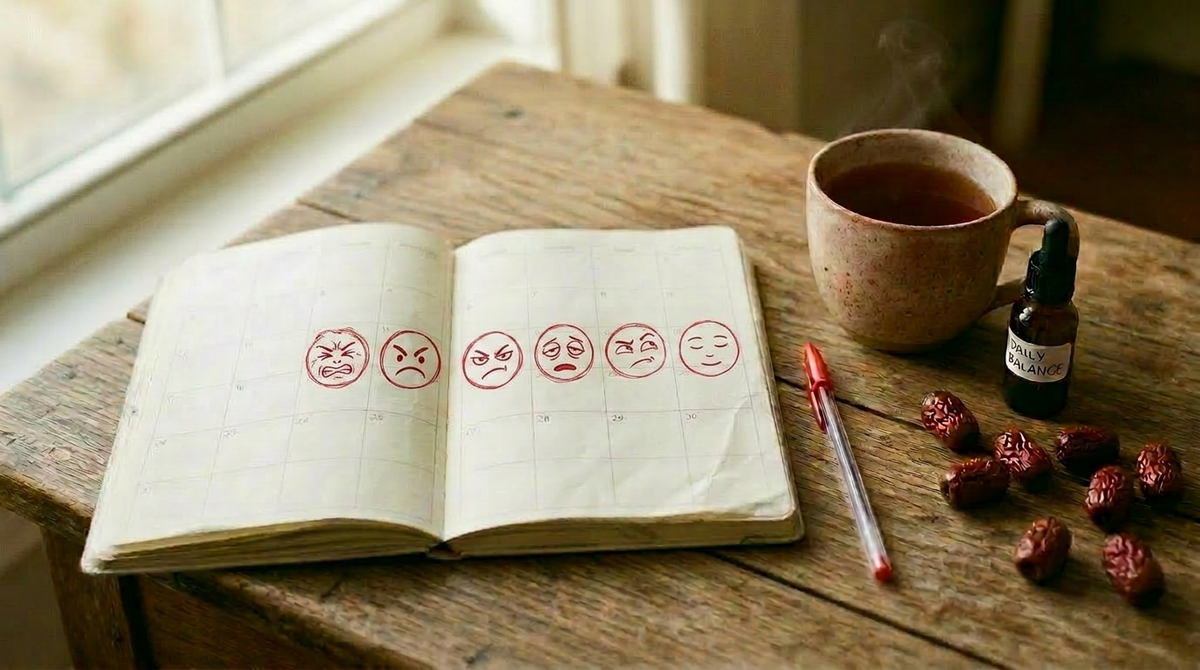
Menstrual Pain: Why It Happens & How TCM Explains It
You would be glad if you could skip a few days every month. They are the dates you put on your calendar but do not look forward to. When you are planning a beach holiday in summer, you would definitely like to cross those dates out. If you miscalculate, your holiday could be ruined.
I wish every woman received a period leave every month.
A gift that feels like a curse.
The ancient Chinese philosopher Mencius said:
"When Heaven is about to confer a great responsibility on a person, it will first exercise their mind with suffering, toil their sinews and bones with hard work, expose their body to hunger, subject them to extreme poverty, and confound their undertakings. In this way, Heaven stimulates their mind, hardens their nature, and remedies their incompetencies."
故天將降大任於斯人也,必先苦其心志,勞其筋骨,餓其體膚,空乏其身,行拂亂其所為,所以動心忍性,曾益其所不能。 (gù tiān jiāng jiàng dà rèn yú sī rén yě, bì xiān kǔ qí xīn zhì, láo qí jīn gǔ, è qí tǐ fū, kōng fá qí shēn, xíng fú luàn qí suǒ wéi, suǒ yǐ dòng xīn rěn xìng, zēng yì qí suǒ néng)
To become a mother — the most sacred role in the world — it seems that menstrual pain is part of the preparation. A training of the body and the spirit, month after month, for what may one day come.
But this does not mean you have to suffer through it. You can relieve the symptoms and live those days as normally as you deserve. TCM has been doing exactly that for thousands of years.
Why menstrual pain happens — the TCM explanation
Western medicine explains menstrual pain primarily through prostaglandins — hormone-like compounds that cause the uterus to contract, restricting blood flow and triggering the cramping, nausea, and lower back pain that many women experience in the first days of their period. The explanation is accurate and useful. But it addresses the mechanism without addressing the underlying condition that makes some women experience severe pain and others almost none.
TCM asks a different question: not what is causing the pain, but why the Qi 氣 (qì) and Blood 血 (xuè) are not flowing freely enough to begin with.
In TCM, menstrual pain is understood as a disruption in the smooth flow of Qi and Blood through the uterus. When Qi and Blood flow freely, the period arrives without significant pain. When they stagnate — held back by cold, by emotional constraint, by deficiency, or by excess — the uterus must work against the obstruction to release what needs to be released. The pain is the effort of pushing through what should flow naturally.
TCM identifies several patterns of menstrual pain, each with a different cause and a different approach. The two most common are:
Qi and Blood stagnation — 氣滯血瘀 (qì zhì xuè yū) — the most common pattern. Cold entering the uterus — from cold foods, cold drinks, sitting on cold surfaces, or being cold during the period itself — causes the Blood to congeal and the Qi to stagnate. The pain is typically cramping, fixed in location, worse with pressure, and relieved by warmth. This is the cold-type dysmenorrhoea that responds dramatically to heat packs, warm drinks, and warming foods and oils.
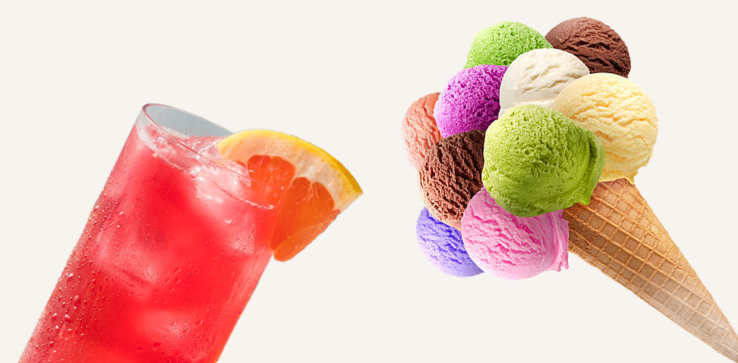
Qi and Blood deficiency — 氣血兩虛 (qì xuè liǎng xū) — the second common pattern, particularly in women who are overworked, under-nourished, or chronically fatigued. When there is not enough Qi and Blood to support the uterine movement, the period arrives weakly and painfully — a dull ache rather than sharp cramping, accompanied by fatigue, dizziness, and a feeling of depletion. This pattern responds to nourishment and rest rather than warming alone.

Both patterns share one underlying principle: the pain is not the problem. It is the signal. The body is telling you that something in the month before — what you ate, how you rested, how much cold you exposed yourself to, how much you held emotionally — has accumulated in a way that the period is now trying to clear.
This is why TCM's approach to menstrual pain is not primarily about treating the pain. It is about changing the conditions that create it.
Summer heat can worsen menstrual pain; learn about summer cooling practices
Diagnosing Your Period Pain: Stagnation vs Deficiency (TCM Model)
Before reaching for any oil or food, the most useful thing you can do is read the pain itself. TCM does not treat menstrual pain as a single condition — it treats it as a signal from a specific pattern. The approach for one pattern is almost the opposite of the approach for the other.
You are likely to have Qi and Blood stagnation if: your pain is sharp, cramping, and fixed in one place. It arrives before or at the start of the period and is worse with pressure — pressing on the abdomen makes it more intense, not less. It improves significantly with heat. The period blood is dark, possibly with clots. You feel more irritable or emotionally tense in the days before the period arrives. You tend to run warm, reach for cold foods instinctively, and feel worse in cold weather.
You are likely to have Qi and Blood deficiency if: your pain is a dull ache rather than sharp cramping. It tends to arrive during or after the period rather than before it, and is accompanied by fatigue, light-headedness, or a feeling of depletion. The period blood is pale or light rather than dark. You feel better with gentle pressure on the abdomen. You are often tired regardless of how much you sleep, and the week before the period tends to leave you depleted rather than tense.
Most women recognise themselves primarily in one pattern, with occasional elements of the other. Read the period that arrives and respond to what it tells you.
For Qi and Blood stagnation — when the pain comes from obstruction
The strategy here is to move, warm, and release. Cold has entered the uterus and caused the Blood to stagnate. The Liver Qi is constrained. The approach addresses both — warming the uterus to dissolve the obstruction and supporting the Liver's function of smooth flow.
The month before the period
Keep warm. Cold is the primary cause of 氣滯血瘀 (qì zhì xuè yū). Cold drinks, cold foods, cold floors, a cold lower back — all of these in the second half of the cycle create the conditions for painful menstruation. Replace cold drinks with warm water, warm ginger tea, or water at room temperature. Keep the lower back covered when the weather changes. This is the single most impactful change most women with this pattern can make.
Manage the Liver Qi. The Liver meridian — 肝經 (gān jīng) — governs the smooth flow of Qi throughout the body. When it is constrained by stress or suppressed emotion, Qi stagnation and a painful period follow. In the ten days before the period, protect your time and reduce commitments where possible. Talk to someone about what you are carrying. The period reflects the month before it.
Move consistently. Walking twenty to thirty minutes daily in the second half of the cycle keeps Qi and Blood circulating and prevents the stagnation that causes cramping. Avoid vigorous high-intensity training in the five days immediately before the period — it spends energy that the body needs directed inward.
Learn about Liver Qi constraint
Aromatherapy to warm and move
The oils for this pattern are moving and warming. They dissolve obstruction and support the downward, releasing direction that the period requires.
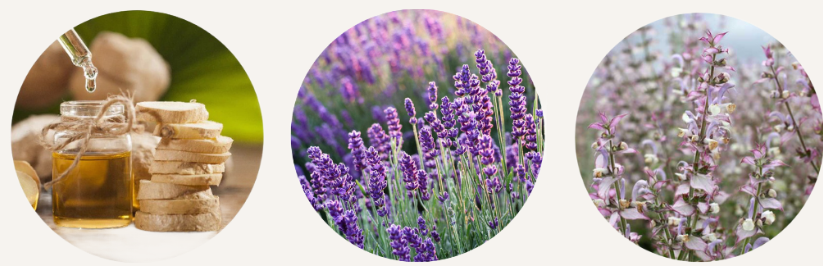
Clary sage — the primary oil for this pattern. Its sclareol content has oestrogen-like activity and directly supports uterine muscle tone, reducing excessive contractions while supporting the natural rhythm of the period. In TCM it moves Qi 氣 (qì) and Blood 血 (xuè) downward, addressing the obstruction at its source. Dilute two drops in ten ml of a carrier oil — sweet almond or sunflower — and massage in slow clockwise circles over the lower abdomen before sleep. Begin the day before the period is expected and continue through the first two days.
Ginger — the warming oil. For cold-type obstruction, ginger is the most directly effective oil available. Its gingerol content produces genuine warmth in the tissue, improving local circulation and dissolving cold-induced stagnation. Dilute one drop in ten ml of carrier oil and massage over the lower abdomen with a warm palm. Begin the day before the period is expected and continue through the first two days.
Lavender — the anti-spasmodic oil. Its linalyl acetate content is among the most researched smooth muscle relaxants in aromatherapy. It calms the Liver constraint that underlies most cases of 氣滯血瘀 (qì zhì xuè yū). Diffuse two drops during the first days of the period.
A simple evening blend for the week before the period: clary sage two drops, lavender two drops. Diffuse for twenty minutes in the bedroom. It supports the sleep you need before the period begins.
Nourishment to warm the body
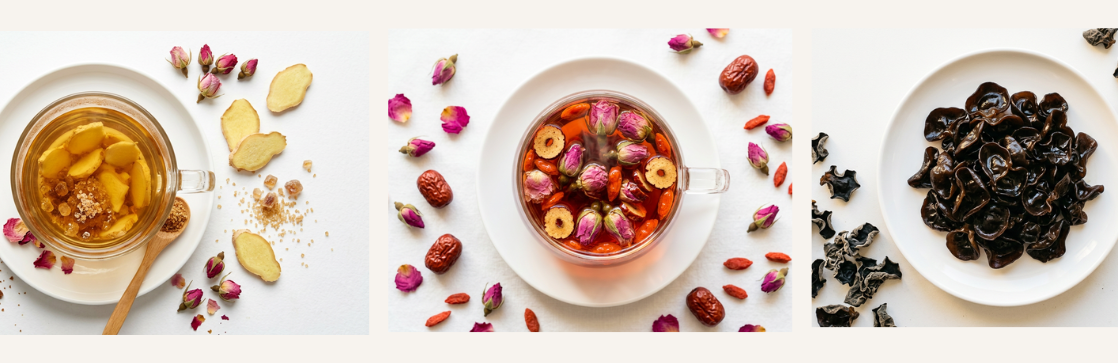
Rose and date tea — 紅棗玫瑰茶 (hóng zǎo méi guī chá). Simmer dried rose petals with three or four pitted dried red dates in freshly boiled water. Rose moves Qi stagnation. Dates nourish the Blood. Together they address both the physical obstruction and the emotional dimension of the premenstrual days. Drink one cup daily in the week before the period is expected.
Brown sugar and ginger tea — 紅糖薑茶 (hóng táng jiāng chá). The most widely used TCM remedy for this pattern. Brown sugar warms the Blood and supports its movement. Ginger warms the uterus and disperses cold. One cup after dinner through the first three days. This is the remedy that has been passed down through generations.
Black fungus — 木耳 (mù ěr). One of the most effective Blood-moving foods in TCM. Stir-fry lightly with soy sauce or add to soups. Soak dried black fungus in warm water for thirty minutes and remove the hard base before cooking. Available in Asian supermarkets across Europe.
What to avoid: cold drinks, ice, raw food in large quantities, alcohol, and excessive caffeine — all of which worsen Qi and Blood stagnation. Avoid them through the first days of the period.
Three practices for the first two days
Apply the clary sage or ginger blend to your lower abdomen and the meridians in lower legs every morning and every evening — five minutes of slow clockwise massage with warm hands. This is the most effective non-pharmaceutical intervention available for this pattern.
Place a hot water bottle on the lower abdomen during the first two days. Warmth is the primary treatment. Keep the lower back covered. Drink nothing cold.
Make a cup of 紅糖薑茶 (hóng táng jiāng chá) the evening before your period begins. Sit with it. Let it warm from the inside out.
For Qi and Blood deficiency — when the pain comes from deficiency
The strategy here is the opposite — nourish, rest, and rebuild. There is not enough Qi and Blood to support the movement the uterus needs to make. Pushing through, warming aggressively, or exercising intensely will worsen the depletion. The approach is patient accumulation.
The month before the period
Build Blood in the second half of the cycle. The ten to fourteen days before the period is the window in which the body prepares the Blood it will release. If those reserves are insufficient — through overwork, poor sleep, irregular eating, or chronic stress — the period that follows will be both weak and painful.
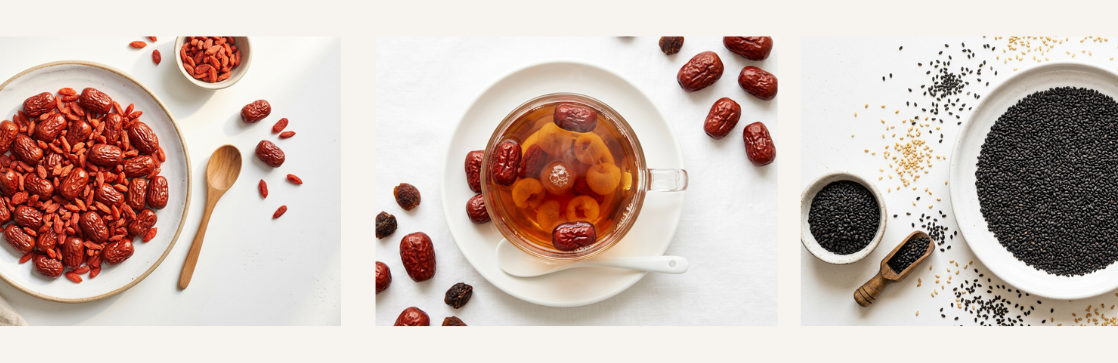
Red dates — 紅棗 (hóng zǎo). Eat three to five daily in the week before the period as a morning snack, or simmer with a few goji berries — 枸杞 (gǒu qǐ) — as a warm tea. The most accessible and most time-honoured Blood-building practice in Chinese medicine, particularly for women prone to anaemia.
Black sesame — 黑芝麻 (hēi zhī ma). Sprinkle on warm food or stir into drinks and cereals. Rich in iron, calcium, and the Kidney-nourishing properties that underlie all Blood production in TCM. Eaten consistently through the cycle, it builds the reserve rather than simply addressing the deficit.
Lean meat and eggs two to three times in the week before the period — the most direct Blood-nourishing foods available. Add a vitamin C source alongside — a squeeze of lemon or a piece of fruit — to increase iron absorption significantly.
Sleep before midnight. The hours between eleven at night and one in the morning are governed by the Gallbladder meridian in TCM — the organ most directly connected to the Liver's Blood storage and release. Every hour of sleep before midnight is worth twice the equivalent after. For the deficiency pattern, this is not optional advice. It is the foundation of everything else.
Gentle movement. Walking twenty to thirty minutes daily, yin yoga poses that open the hips and lower back, and the slow deliberate movements of qigong build Qi rather than spend it. Avoid high-intensity training in the five days immediately before the period. Vigorous exercise depletes what this pattern most needs to preserve.
Aromatherapy to nourish and ground
The oils for this pattern are nourishing and grounding. They build and gather rather than move and disperse.
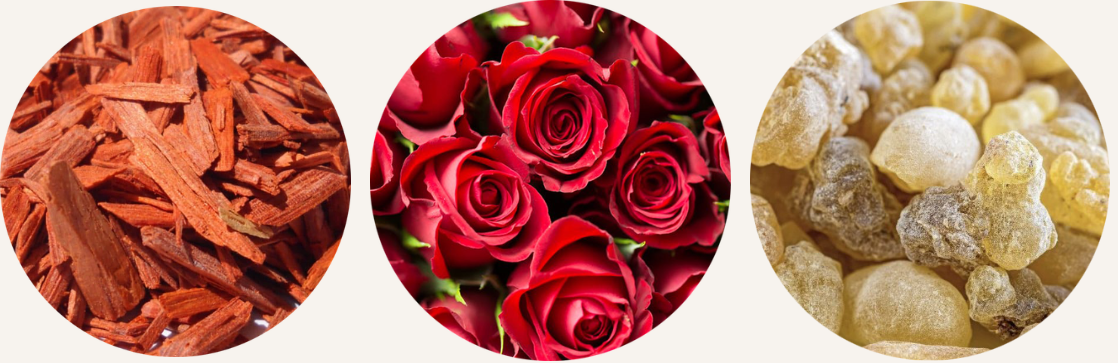
Rose — one drop in ten ml of sweet almond oil, massaged over the lower abdomen. Rose nourishes the Blood and the Heart simultaneously. It is the oil for the woman whose pain comes from having given too much. Its citronellol content has documented anti-anxiety and mood-regulating properties — the Western confirmation of TCM's understanding of rose as a Blood and Heart nourisher.
Frankincense — supports the Kidney essence — 精 (jīng) — the deep reserve that underlies all Blood production in TCM. Where ginger and clary sage move energy outward, frankincense gathers it inward. For the deficiency pattern this inward gathering is precisely what is needed. Its alpha-pinene and incensole acetate content has demonstrated anxiety-reducing and neurologically calming properties, supporting the quality of rest that rebuilding requires.
Sandalwood — the Water element — 水 (shuǐ) — oil. Deeply grounding, supporting the Kidney meridian and the body's capacity to replenish. For the woman who cannot slow down even when her body is asking her to, sandalwood creates the conditions for rest that willpower alone cannot manufacture.
A simple evening blend for the week before the period: frankincense two drops, sandalwood one drop. Diffuse for twenty minutes in the bedroom. Let the room settle. Then rest.
Nourishment to reserve and replenish
Warm soups rather than cold salads. The Spleen and Stomach transform food into Blood in TCM. Cold and raw foods burden them. In the week before the period this distinction matters more than at any other point in the cycle.
Spinach and watercress, lightly cooked — not raw. Rich in iron and Blood-nourishing properties. Cooking makes the iron more bioavailable and is gentler on the Spleen.
Red date and longan tea — 紅棗桂圓茶 (hóng zǎo guì yuán chá). Simmer five pitted dates and five longan pieces in freshly boiled water. Drink warm in the later days of the period and for one week after, to replenish what was released.
What to avoid: excessive cold foods and drinks, skipping meals — the Spleen cannot build Blood from nothing — and overwork or late nights in the week before the period. These are the specific behaviours that create and maintain the deficiency pattern.
Three practices for the first two days
One drop of rose and two drops of frankincense in ten ml of a carrier oil of your choice. Apply over the abdomen and the meridians in lower legs in slow, gentle strokes every morning and evening. This is not the time to move and warm. It is the time to receive and replenish.
Rest without guilt. Lie down in the afternoon if you can. Sleep before ten on the first two days if you can manage it. The period is the body asking for a return of what has been spent. The most productive response is to give it.
If you feel weak, light-headed, or dizzy, and the flow is lighter than usual, make a cup of red date and longan tea each morning of the first two days. Sit with it before the day begins.
What the ancient Chinese philosopher was really saying
故天將降大任於是人也 (gù tiān jiāng jiàng dà rèn yú shì rén yě).
When Heaven is about to confer a great responsibility, it first asks for the endurance that makes that responsibility possible to carry.
When I was a teenager, I once wished I could be free from menstrual cycles entirely — free from the inconvenience, the discomfort, and the pain. I was paralysed for two days every month, unable to do or eat anything. Not to mention the embarrassment of discovering blood-stained clothes in a classroom or at a restaurant with friends.
Only when I became a mother did I understand that the capacity to carry a new life is the most sacred thing I will ever be given. The place where life begins needs to be cleared, well-prepared, and strong.
Everything that happens in your life has a reason. You may just not know it yet. Protect, reserve, and nourish this most special part of yourself.
Can I use essential oils?
Clary sage should not be used during pregnancy or when pregnancy is suspected. Its uterotonic properties that make it effective for menstrual pain are precisely why it is contraindicated in early pregnancy. If you are trying to conceive, use lavender and rose only during the luteal phase and avoid clary sage until the period confirms a non-pregnant cycle.
Ginger oil is a potential skin sensitiser. Always dilute to a maximum of one percent — one drop per ten ml of carrier oil — for topical abdominal application. Do not apply undiluted.
Rose absolute versus rose essential oil — genuine rose essential oil is expensive. Rose absolute is more accessible and equally effective for the emotional and hormonal work described in this article. Either is appropriate.
Always dilute before applying to skin. The standard adult dilution of two to three percent — two to three drops per ten ml of carrier oil — applies throughout. For sensitive skin during the period, stay at one to two percent.
If your menstrual pain is severe, worsening over time, or accompanied by other symptoms — heavy bleeding, pain outside the period, pain during intercourse — please consult your GP or gynaecologist. Severe menstrual pain can be a symptom of endometriosis or other conditions that require medical investigation. Aromatherapy supports the management of primary dysmenorrhoea. It is not a substitute for medical evaluation of secondary dysmenorrhoea.