Carrier Oil Guide: Choose the Right Oil for Your Skin Type
Discover which carrier oils suit your skin type—dry, oily, mature, sun-damaged. Learn to blend them for nourishing morning and evening rituals that actually work.

The Carrier Oil: Foundation of Every Skincare Ritual
The carrier oil is not a neutral vehicle for delivering essential oils to the skin. It does its own work—nourishing, protecting, treating—through its fatty acid profile, vitamin content, and lipid structure. A beautifully chosen essential oil in the wrong carrier underperforms. A well-chosen carrier alone can change a skin condition on its own.
This guide covers the top 10 carrier oils most relevant to daily skincare, how to choose by your skin type—dry, oily, mature, sun-damaged—and how to blend them for morning and evening rituals. You will learn what each oil does, who it suits best, and how to identify quality oils worth your skin's time. By the end, you will have the knowledge to build a carrier oil blend designed specifically for your skin's needs in this season and this moment.
Previous story
← My Daily Rituals & Blend Recipes
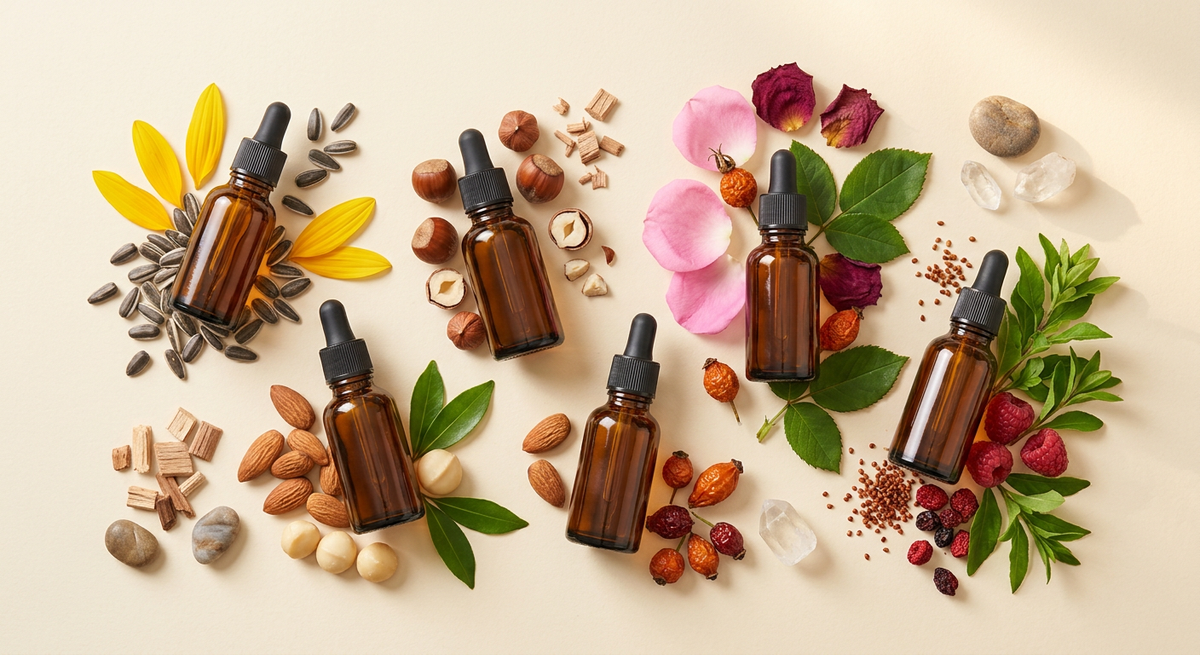
Top 10 carrier oils
1) Sunflower seed oil — the one I use most
Light, easily absorbed, and rich in linoleic acid and vitamin E, sunflower is one of the gentlest carriers available — particularly valuable for skin that has become more reactive than it used to be. Its vitamin E content offers genuine antioxidant protection against the everyday oxidative stress that shows up over time as dullness and fine lines.
It has little scent of its own and absorbs quickly without residue, making it a good base whenever you want an essential oil's character to lead without the carrier adding weight of its own.
2) Jojoba oil — the one I always include
Technically a liquid wax rather than a true oil, jojoba's structure closely resembles human sebum. The skin recognises it as something already familiar, which is why it balances rather than adds — oily skin does not become oilier, and dry skin is not left wanting. As natural sebum production declines over time, this resemblance to what the skin used to make on its own becomes especially valuable.
Jojoba is also the most stable carrier available, with the longest shelf life in the toolkit — a reliable oil to always have on hand.
3) Sweet almond oil — the one I use for my face cleanser
The most versatile everyday carrier. Rich in oleic and linoleic fatty acids, it penetrates deeply without leaving a heavy film and suits nearly every skin type, from normal to dry. It has a nutty scent and pairs well with ground almond and apple cider vinegar to make an effective natural face cleanser.
It is a mild carrier oil, suitable for children too.
4) Hazelnut oil — for combination and oily skin
True to its name in scent, hazelnut oil is slightly astringent and fast-absorbing, and suits combination and oily skin well. Its mild toning effect helps balance excess oil without the stripping feeling of harsher astringents — useful for skin that runs oily in some areas and dry in others, a pattern that tends to become more common rather than less over time.
5) Macadamia oil — for mature skin
Rich and deeply nourishing, macadamia is one of the few plant oils to contain palmitoleic acid — a fatty acid that closely resembles the lipids found in younger skin and that naturally decreases with age. This is what makes it so useful for mature skin: it replenishes something the skin is losing rather than simply adding moisture from outside.
Best for dry, depleted, or aging skin, it blends well with a lighter carrier such as sunflower in a daily body oil, where macadamia alone might feel heavier than wanted.
6) Rosehip oil — for everyday regeneration
One of the most celebrated carriers in skincare, and deservedly so. Exceptionally rich in vitamin A and vitamin C, both essential to collagen production and skin renewal, rosehip also carries a naturally occurring retinoic acid content that gives a gentle retinol-like effect without the irritation synthetic retinol often causes.
It is the carrier of choice for fading hyperpigmentation, softening fine lines, and supporting elasticity over time — one of the few capable of visibly changing the skin's texture and tone with consistent use over weeks and months. Not an instant fix, but a genuine long-term investment.
7) Carrot seed oil — a small amount only, for regeneration
Used in small percentages within a blend rather than as a standalone carrier, carrot seed is prized for supporting skin cell regeneration and for its long association with evening out skin tone. It is frequently included in blends addressing dullness, age spots, and the cumulative effects of sun exposure.
Its aroma is strong, so it is almost always blended at five to ten percent of the total carrier content. Combined with rosehip or sweet almond, it adds a regenerative quality to what the other carriers are already doing. Excessive use over a long period can turn the skin tone slightly yellow.
8) Raspberry seed oil — for everyday SPF
Quietly remarkable and consistently underestimated, raspberry seed oil contains a naturally high concentration of ellagic acid, and its fatty acid profile gives it genuine broad-spectrum UV protection — an estimated SPF of 28 to 35, the highest of any natural carrier oil.
It is the ideal base for a morning facial oil on an ordinary day of brief outdoor exposure. It is not a substitute for dedicated sunscreen on a day of real sun exposure, but it is a genuine layer of protection for the desk-to-commute reality of most days.
9) Avocado oil — for very dry skin
Heavy, rich, and deeply penetrating, avocado oil is high in vitamin E, vitamin A, and beta-sitosterol, a compound with documented anti-inflammatory properties. Best suited to very dry, depleted, or mature skin, it is one of the few carriers capable of genuinely softening rough or thickened skin on the elbows, heels, or knees.
True avocado oil is greenish and cloudy, often with a little residue settled in the bottle. The scent is not necessarily pleasant to everyone. It is often best used in small amounts within a body oil rather than as the main carrier in a daily facial blend.
10) Coconut oil — for very dry skin, best used alone
Solid at room temperature and rich in lauric acid, coconut oil has genuine antimicrobial properties and a luxurious, deeply moisturising quality popular for very dry skin and hair. It is best reserved for body use rather than facial application, and works particularly well as a hair treatment, where its penetrating quality strengthens the hair shaft from within.
Coconut oil has a dominant scent, so I do not use it as a carrier for essential oils, but I often use it alone in winter. Some people use fractionated coconut oil (FCO), which has been highly refined to become odourless and to stay liquid at room temperature. However, the most valuable fats, including lauric acid, are filtered out during this refining process, and the oil loses much of its natural therapeutic value.
Quick Reference Table
| Skin type | Best carrier oils |
|---|---|
| Normal | Sweet almond, sunflower, jojoba |
| Dry to very dry | Avocado, macadamia, coconut |
| Oily | Jojoba, hazelnut, sunflower |
| Combination | Hazelnut, jojoba, sweet almond |
| Mature / losing elasticity | Rosehip, macadamia, avocado, carrot seed |
| Sun-damaged / uneven tone | Rosehip, carrot seed, raspberry seed |
How to Read Labels
Before any blend is worth making, the oil inside the bottle needs to be what it claims to be.
A genuine, unrefined, cold-pressed carrier oil looks and smells like the plant it came from. It is not always pretty. Avocado oil in its true form is a deep, cloudy green, thick in texture, and often has a faint sediment settled at the bottom of the bottle. This is normal, not a flaw. Macadamia carries its own warm, slightly buttery note. Hazelnut and sweet almond oil are both true to their nutty scent.
If a carrier oil arrives perfectly clear, faintly or entirely odourless, and pours like water regardless of which plant it claims to come from, it is likely to have been refined — stripped through heat, chemical solvents, or bleaching to extend shelf life and produce a uniform, inoffensive product. This process also strips away the vitamins, fatty acids, and plant compounds that make the oil therapeutic in the first place.
A simple way to check before buying: look for the words unrefined and cold-pressed on the label. Organic certification is a useful additional signal, but not a guarantee on its own — an oil can be organic and still refined. The most reliable test is your own senses. Real oil has real colour and real scent. If it has neither, it is unlikely to be doing the work you are asking of it.
4 Blending Examples
A single carrier rarely does everything you want. The table above tells you where to start, but the more useful skill is combining two or three oils so each one does a specific job — and the blend as a whole feels right on the skin, neither too heavy nor too thin, with a scent you actually want to wear.
A few working examples:
1) Evening oil for very dry skin
Avocado 30% · Macadamia 30% · Sunflower 20% · Jojoba 10% · Rosehip 10%
Avocado and macadamia carry most of the richness this skin needs, but unrefined avocado has a strong, grassy scent that not everyone enjoys wearing to bed, so it stays a supporting player rather than the whole blend. Sunflower thins the heaviness of the avocado and macadamia, keeping the texture wearable rather than greasy. Jojoba brings the blend back into balance — its resemblance to the skin's own sebum keeps anything this rich from sitting on the surface. Rosehip closes the blend with its renewing, healing character, doing quiet repair work overnight while the rest of the carriers handle the moisture.
2) Morning oil for normal to dry skin
Raspberry seed 50% · Sweet almond 30% · Jojoba 20%
Sweet almond is the steady, everyday base. Raspberry seed is there specifically for the morning — its naturally high SPF, in the range of 28 to 35, gives a mild layer of sun protection before the day begins. Jojoba keeps the texture light enough to sit comfortably under makeup or sunscreen if either follows.
3) Evening oil for combination or oily skin
Hazelnut 40% · Jojoba 40% · Sunflower 20%
Hazelnut's gentle toning effect addresses the oilier areas without stripping the skin, while jojoba balances the drier patches that combination skin often has at the same time. Sunflower keeps the whole blend light enough to wear overnight without feeling like a barrier.
4) Morning oil for mature or sun-damaged skin
Rosehip 30% · Raspberry seed 30% · Macadamia 20% · Carrot seed 10% · Sunflower 10%
Rosehip and carrot seed work on tone and renewal. Macadamia replenishes what the skin has stopped producing on its own. Raspberry seed, again, supplies the morning's mild sun protection. Sunflower dilutes the carrot seed's strong scent, which is too assertive to wear undiluted.
Adding Essential Oils for Personalization
The ten oils above are the foundation of a daily ritual — the ones you reach for every morning and evening.
A practical habit worth building: mix small. A 10ml bottle is enough for several weeks of daily use, and small batches mean you are never stuck with a blend you have outgrown or simply gone off. Make a new one when the last bottle runs low, and let it be slightly different each time — a different carrier ratio, a different scent, a response to whatever the skin or the season is asking for that month. The blend is allowed to change as often as you do.
What you need now is to complete the oil blends with essential oils. Then the oil blend will be highly personalized for you. Continue reading to the next story to the daily essential oil rituals.
Continue reading
→ Daily Essential Oil Rituals: Meridian Massage & TCM Practice