Therapeutic Carrier Oils: TCM Remedies for Specific Conditions
IFPA professional guide to therapeutic carrier oils—hemp seed, walnut, peach kernel, calendula. Learn which oils heal eczema, scarring, wounds, and inflammation.

When Daily Rituals Aren't Enough: Therapeutic Carrier Oils
The daily carrier oil supports your skin type — dry, oily, mature. It maintains equilibrium. But there are moments when the body is asking a different question: what do I need when something feels off?
This is when you reach for a therapeutic carrier oil.
These oils carry documented character within TCM tradition. They work through a different logic than daily maintenance — not What suits my skin type? but What does my body need right now? They tonify what's depleted. They regulate what's stuck. They clear what shouldn't be there.
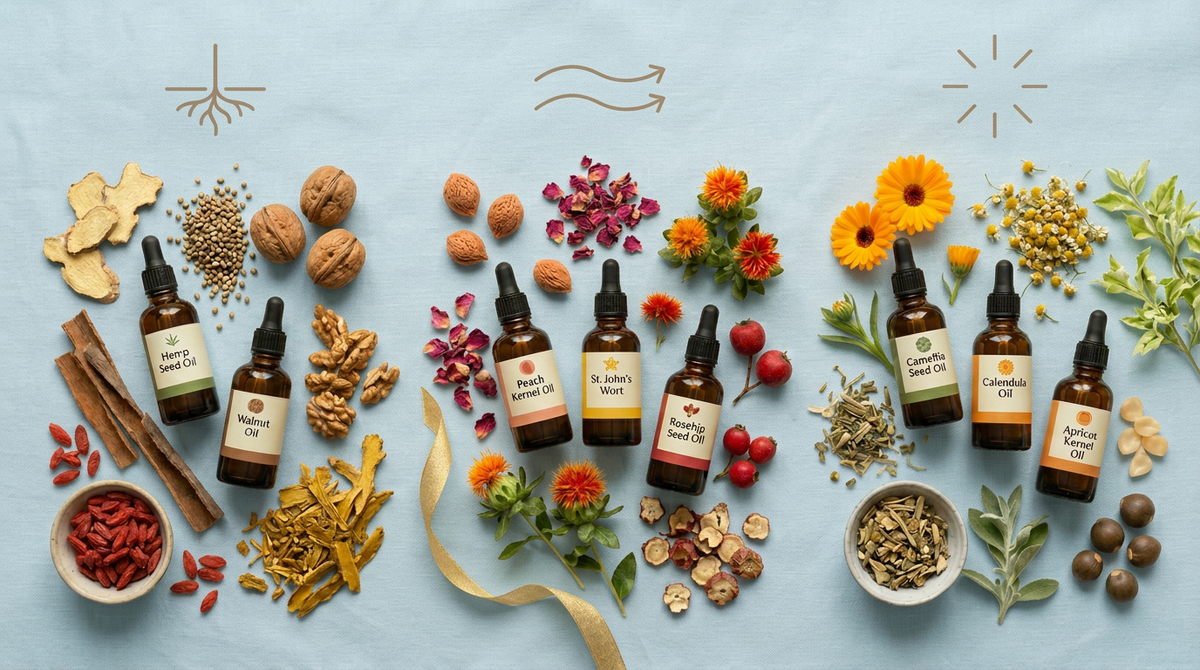
This guide covers the therapeutic carriers most useful at home: hemp seed oil for chronic dryness and depleted skin barrier. Walnut oil for deep cold. Peach kernel oil for old bruising and scarring. St. John's Wort for nerve-related pain. Camellia and calendula for heat, inflammation, and slow-healing wounds. Apricot kernel for dry cough and raw respiratory tissue.
The categories below, tonifying, regulating, clearing, come from how modern TCM teaching organises herbs by what they treat. They're useful here because that's how I reach for these oils.
Previous story
← Therapeutic Essential Oil Rituals: Acupuncture Points & TCM Practice
Tonifying oils — 補益類 (bǔ yì lèi)
These replenish something the body has run low on, whether fluid or warmth.
Tonify Yin
1) Hemp seed oil — 火麻仁油 (huǒ má rén yóu)
Hemp seed oil tonifies Yin, nourishing the body's fluids and easing the dryness that comes with a depleted constitution. Rich in gamma-linolenic acid, it has genuine, well-studied benefits for restoring a compromised skin barrier. I reach for it when dryness has become chronic enough that the skin's own barrier function seems to have broken down, eczema-prone skin, or skin that's been over-treated and needs rebuilding rather than simply moisturising.
Hemp seed itself, 火麻仁 (huǒ má rén), has its own place in TCM independent of the pressed oil, traditionally used in small amounts as a gentle remedy for dry constipation linked to Yin deficiency. A teaspoon of hemp seeds stirred into a smoothie or porridge works on the same principle as the oil does on the skin, easing dryness from within.
Buy a cold-pressed, unrefined oil and store it in the fridge. It oxidises faster than most carriers on this list.
Tonify Yang
2) Walnut oil — 核桃油 (hé táo yóu)
Walnut tonifies Yang, warming the body's internal fire and dispelling the deep cold that settles into the Kidneys and lower back. It's the most warming oil on this list, and the one to reach for when you feel coldness, lower back weakness, brittle bones, joint pain that worsens distinctly in cold weather, or a chilled, heavy fatigue.
Blend a small amount with ginger or black pepper essential oil and apply with firm pressure to the lower back or the soles of the feet, working toward the lymph nodes, underarm or behind the knee, to support drainage as you go.
Choose an unrefined, cold-pressed oil rather than a culinary walnut oil from the supermarket, which is pressed for flavour rather than therapeutic content.
Regulating Blood and Qi — 理血氣類 (lǐ xuè qì lèi)
Where tonifying replenishes what's deficient, this category moves what's become stuck. Stagnation and deficiency call for opposite approaches, so it's worth taking a moment to observe your body and decide which one you're actually dealing with before reaching for an oil.
Regulate Blood
3) Peach kernel oil — 桃仁油 (táo rén yóu)
Peach kernel invigorates Blood flow, breaks up stagnation, and resolves bruising, used classically wherever Blood has become stuck rather than simply thin. I reach for it on a specific area of poor circulation, an old bruise that won't fade, skin thickened over a scar, the kind of localised stiffness that feels like something simply isn't moving. The same Blood-moving action that breaks up stasis beneath the skin supports cellular turnover at the surface, which is part of why it's traditionally used on stubborn pigmentation and old scarring as much as on bruising itself.
Peach kernel oil is harder to find but is carried by most specialist carrier oil suppliers.
4) Rosehip oil
Where peach kernel is a heavy-duty, piercing oil for hardened, stubborn stasis, rosehip behaves more like a gentle, nourishing regulator, suited to long-term use rather than a single sharp intervention. It works on the same localised stagnation beneath the skin, gradually clearing the pigmentation that lingers after it.
Rosehip is already covered in the daily ritual article for its regenerative, tone-evening work, so if it's already on your shelf, it's a reasonable place to start.
Regulate Qi
5) St. John's Wort macerated oil (Hypericum)
St. John's Wort isn't a classical Chinese herb, the plant is native to Europe and has no entry in the Ben Cao Gang Mu. But its documented Western use sits close enough to this category. Made by macerating the flowering tops in a base oil, usually olive, until the oil turns a deep, distinctive red, it has a long-standing reputation in European herbal medicine for nerve pain, neuralgia, and mild bruising, the kind of discomfort that sits along a nerve pathway rather than in a joint or muscle.
I reach for it on sciatica-type pain, the ache that runs along a nerve rather than sitting in one place, and on bruising where the skin itself isn't broken. It pairs well with lavender or Roman chamomile for nerve-related tension that has a restless, agitated quality to it.
One real caution: St. John's Wort oil is photosensitising. Skin treated with it shouldn't be exposed to direct sun for several hours afterwards, so it's better suited to evening use or to areas that will stay covered.
Carrier oils rarely hold Qi-moving properties on their own. Where this category really opens up is in essential oils, bergamot, sweet orange, cypress, neroli, mandarin, which we'll return to properly in a future article.
Clearing and eliminating — 祛邪類 (qū xié lèi)
This category addresses what shouldn't be there, excess heat or stuck fluid.
Clear Heat
6) Camellia seed oil — 山茶花油 / 茶籽油 (shān chá huā yóu / chá zǐ yóu)
Camellia seed oil clears heat and reduces inflammation, used in Chinese tradition to cool toxic fire and calm rashes. It has a long history of soothing burns, calming inflamed skin, and brightening a complexion dulled by accumulated heat. Its astringent quality also tightens congested or visibly enlarged pores as it cools, which is why it's reached for on hot, angry, acne-prone breakouts specifically as well as on heat and inflammation more broadly. I use it on skin that feels hot, reactive, or congested, the kind of breakout that comes with frustration or a stretch of poor sleep as much as with anything topical.
7) Calendula macerated oil (Marigold)
Calendula isn't part of the classical Chinese tradition either, but the same cooling, dispersing logic applies to it as to camellia. Made by macerating the flower petals, usually in sunflower oil, it's reached for when localised heat, irritation, or what TCM would describe as damp-heat has settled into the skin, producing tissue that's angry, red, inflamed, or weeping rather than simply dry.
What sets calendula apart from camellia is its gentler, more dispersing quality on Blood that's become locally stuck beneath inflamed tissue. This makes it particularly useful for accelerating slow-to-close wounds and superficial ulceration, and for discouraging the rigid, raised scar tissue that can form while skin heals badly. I reach for it on anything that's actively weeping or struggling to close, ahead of camellia, which suits skin that's hot and congested but already intact.
Transform Phlegm and Stop Cough
8) Apricot kernel oil — 杏仁油 (xìng rén yóu)
Apricot kernel moistens the Lung, stops dry coughs, and expands the chest, the classical choice when the concern is genuinely respiratory, a tight chest, a throat that feels parched. The same moistening action that calms a dry cough from within does comparable work on the surface, softening skin that's become raw or flaky and easing the itch that comes with it.
9) Sweet almond oil
Sweet almond shares apricot kernel's family, both are Prunus, and shares its Lung-directed, moistening character. That family relationship is why I use the two oils for the same purpose. When the concern is dryness with a respiratory edge, or skin that's become raw, itchy, or inflamed from any cause, I reach for whichever is already on the shelf. Most readers already have sweet almond from the daily ritual.
Blend either oil with frankincense or eucalyptus and massage slowly across the chest. For irritated skin elsewhere on the body, either can be used alone, with no essential oil added, until the irritation has settled.
Quick Reference Table
| Category | Oil | Primary action |
|---|---|---|
| Tonify Yin | Hemp seed oil | Nourishes fluids, eases deficiency dryness, restores skin barrier |
| Tonify Yang | Walnut oil | Warms deep Kidney cold, penetrates tight muscle, supports lymphatic drainage |
| Regulate Blood | Peach kernel oil, or rosehip | Invigorates Blood flow, breaks stagnation, resolves bruising and scarring |
| Regulate Qi | St. John's Wort macerated oil | Eases nerve-related pain and mild bruising; photosensitising, evening use only |
| Clear Heat | Camellia seed oil, or calendula macerated oil | Reduces inflammation, cools toxic fire, calms rashes, congested pores, and slow-healing wounds |
| Transform Phlegm / Stop Cough | Apricot kernel oil, or sweet almond | Moistens the Lung, stops dry cough, softens raw or irritated skin |
How to use this table
Some of these carrier oils, like sweet almond and rosehip, are covered in the daily rituals, but the others are meant to be set aside for the moment when special care is required.
You don't need to buy everything tonight. Most readers will already have sweet almond and possibly rosehip from the daily ritual, which covers two of these functions without any new purchase. Depending on what you need most, it's worth building a small collection over a season or two to answer that moment when it arrives.
Building Your Collection
A complete therapeutic blend usually needs a carrier and an essential oil paired together, sometimes a few of each. Some functions, regulating Qi and calming the Shen among them, are carried almost entirely by essential oils rather than by anything pressed or macerated.
Going forward, I'll share complete blend recipes built around the specific problems you're encountering, in a season or at a stage of life. To personalize your rituals, it is best to find out your own TCM pattern—which element you are among Wood, Fire, Earth, Metal, and Water.
Continue reading