Spleen Qi Depletion in Pregnancy: TCM Nutrition by Trimester
Master pregnancy nutrition across all three trimesters using TCM's organ-system approach. Discover what to eat in each trimester—from nourishing Spleen foods to heat-clearing remedies.

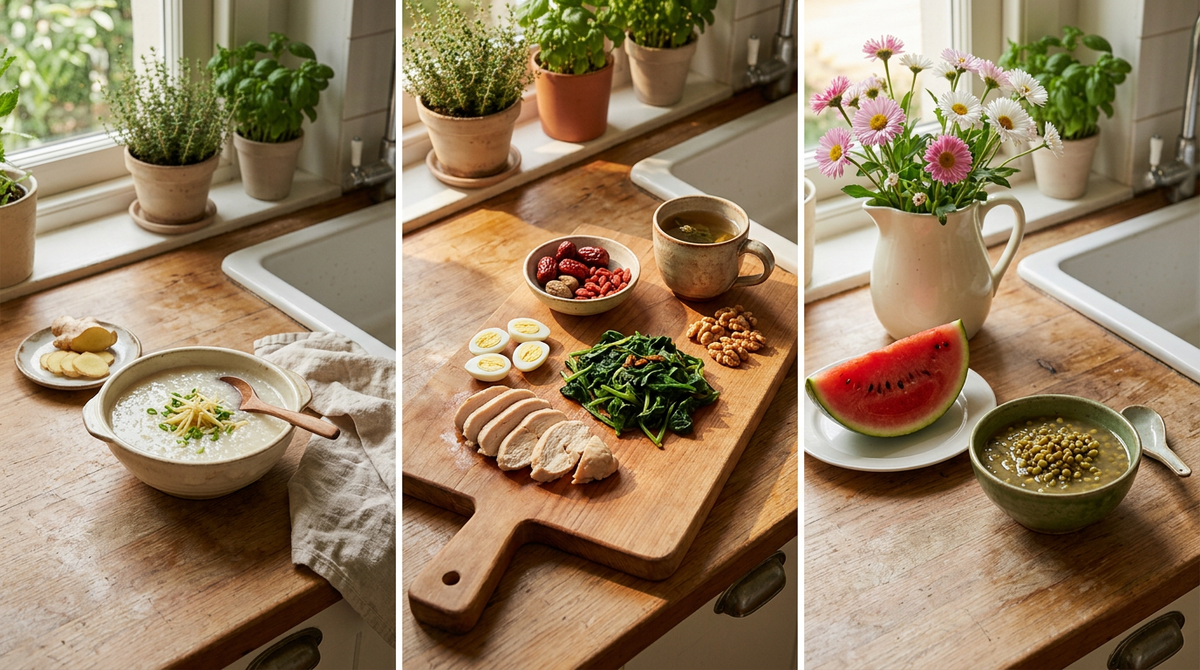
Pregnancy nutrition works differently in each trimester because...
Western pregnancy nutrition focuses primarily on nutrients — folic acid in the first trimester, iron and calcium in the second, omega-3s in the third. The guidance is accurate and important. But it does not explain why your body craves completely different foods at twelve weeks, or why the same meal that felt comforting in the first trimester becomes impossible in the third.
TCM explains this through the lens of the season within a season. Each trimester has its own governing organ system, its own energetic direction, and its own nutritional logic. Eating in alignment with that logic — rather than following a single list of approved foods throughout — is how TCM has supported healthy pregnancy.
This guide pulls together the wisdom from the three trimester articles on The Scented Compass into one practical reference. Return to it each trimester and eat accordingly.
First trimester nourishment — 靜以致遠 (jìng yǐ zhì yuǎn)
Through stillness, we reach what is far.
The nausea and food aversions of early pregnancy are not random. In TCM they signal that the digestive system is temporarily overwhelmed. It is asked to sustain a life it has never sustained before, while also managing the most profound hormonal shift your body has ever experienced. The Stomach and Spleen — the organs responsible for transforming food into nourishment — need warmth, simplicity, and consistency above everything else.
The Four Natures framework is clear for this trimester: avoid cold, raw, and hard-to-digest foods. The body is in a state of storing and preserving —藏 (cáng) — and everything it receives should support that inward, conservative energy.
What helps:
Warm congee with fresh ginger — plain, simple, and taken in small amounts before getting out of bed if morning sickness is severe. Congee's long slow cooking makes it easy for the Stomach to receive. Ginger is warming and pungent — upward-moving in TCM — and one of the most well-researched natural remedies for pregnancy nausea in both Eastern and Western medicine. A small bowl before you are fully vertical can shift the entire quality of the morning.
Plain rice and steamed vegetables — when everything else is impossible, this is the foundation. Warm, uncomplicated, gentle on the Stomach. Not raw. Not cold. Not heavily seasoned.
Small amounts frequently — the Stomach in early pregnancy does better with small, consistent inputs than with full meals. Do not wait until you are hungry. Keep plain crackers or rice cakes on the bedside table. Eat before you get out of bed if possible.
Ginger tea — warm, not hot. Fresh ginger sliced into boiled water, with a small amount of honey if needed. Taken first thing in the morning and after meals.
What to limit:
Raw salads and cold foods are cooling in nature and harder to digest, taxing a Spleen that is already under pressure. Replace cold drinks with warm water, warm ginger tea, or water at room temperature. Rich, oily, or heavily spiced foods burden the Stomach and frequently worsen nausea.
The single most impactful dietary change most women report in the first trimester: switching from cold to warm drinks. It costs nothing and takes effect immediately.
For aromatherapy and practices to support the first trimester, see First Trimester TCM: Rest, Nourishment & Pregnancy Relief.
Second trimester nourishment — 生生不息 (shēng shēng bù xī)
Life generating life, the endless renewal.
The appetite has returned — and it has returned with ambition. In TCM the second trimester is the season for nourishing the Blood — 血 (xuè) — the substance that carries life and essence to the growing body inside you. The governing principle is clear and gentle nourishment — 清補 (qīng bǔ). Not aggressive supplementation or heavy tonics. Nutritious, easily digestible, and consistent.
As the saying goes in TCM: strengthen the Spleen to produce Blood; tonify the Kidney to generate Essence. The foods that serve both functions are the foundation of second trimester eating.
Lean meat and fish — lean pork, chicken, and fish are the TCM preferences for this trimester. Warming without being excessive, building without burdening the digestion. Quail eggs, if you can find them, are considered particularly nourishing for the developing baby — small, easily digestible, and rich in the nutrients that Blood nourishment requires.
Eggs — fully cooked, scrambled or boiled. Simple, warm, and one of the most complete sources of nourishment available.
White kidney beans and peanuts — familiar to the European kitchen and directly applicable here. Lightly cooked, warm, and easily digestible. Peanuts should be cooked rather than raw, as cooking makes them more easily processed by a digestion that is already working harder than usual.
Dark leafy greens — spinach, watercress, and dark kale, lightly cooked rather than raw. Cooking makes the iron more bioavailable and is gentler on the digestion, which is still adjusting to the change in appetite.
Dried red dates and walnuts — 紅棗 (hóng zǎo) — a traditional Chinese pairing for pregnancy. Dates nourish the Blood and calm the mind. Walnuts, which resemble a brain in their shape as the ancient herbalists noted, support the nervous system development of the baby. A handful of each as a morning snack is one of the simplest and most time-honoured practices in Chinese pregnancy nutrition.
Black sesame — 黑芝麻 (hēi zhī ma) — rich in calcium, iron, and the warming qualities TCM associates with Kidney nourishment. Sprinkle on rice, stir into warm almond milk, or mix into cereal.
Warm water and soups — the appetite has returned but the digestive system is still working harder than usual. Warm liquids before and after meals support digestion and help the body absorb what it is being given. Cold drinks, however tempting as the belly grows and the body warms, slow the digestion and burden the system.
What to avoid:
Ginseng and deer antler — the great warming tonics of Chinese medicine — are contraindicated in pregnancy because their strong heating nature can raise blood pressure and encourage the baby to grow too large. The body does not need aggressive supplementation. It needs consistent, gentle, well-chosen nourishment. Certain Chinese medicinal herbs can also stimulate uterine contractions — 川七 (chuān qī), 丹參 (dān shēn), and 紅花 (hóng huā) should not be used during pregnancy in any form.
Learn more about energy expansion in the Second Trimester TCM Guide.
Third trimester nourishment — 清胎毒 (qīng tāi dú)
Clearing foetal toxins for a healthy arrival.
The third trimester introduces a nutritional principle specific to the final weeks of pregnancy: 清胎毒 (qīng tāi dú) — clearing foetal toxins. The theory, passed through generations of Chinese families, is this: if heat, dampness, or internal fire accumulates in the mother's body during pregnancy — through diet, stress, insufficient rest, or the natural heat-generating process of carrying a child — it can be transmitted to the newborn. The result, in TCM understanding, is the newborn skin conditions that many European parents have encountered: neonatal eczema, red rashes, neonatal jaundice.
From around week thirty-five, the dietary restriction on cooling foods that applied throughout the pregnancy loosens. Cooling foods are now introduced gradually and moderately, for the specific purpose of 清熱解毒 (qīng rè jiě dú) — clearing heat and resolving toxins.
Mung beans — 綠豆 (lǜ dòu) — the most important food in 清胎毒 practice. Cold in nature, sweet in flavour, and one of the most effective 清熱解毒 foods in TCM. Cantonese mung bean soup — 綠豆沙 (lǜ dòu shā) — is the classic preparation. Simmer mung beans in water until soft and drink the liquid warm or at room temperature. Dried mandarin peel and kelp strips are used in the original recipe — if unavailable in your region, the soup retains its effect without them. Start in week thirty-two, one to two times per week.
Chrysanthemum tea — 菊花茶 (jú huā chá) — cooling, slightly bitter, and directly 清熱 in action. Steep five to eight dried chrysanthemum flowers in freshly boiled water. One cup per day in the final weeks, warm rather than hot, with a small amount of honey to balance the bitterness.
Watermelon — cooling and diuretic. In TCM watermelon is cold in nature and sweet in flavour. It clears heat, promotes urination, and directly addresses the fluid retention and swelling that the third trimester accumulates. Eat at room temperature rather than cold from the refrigerator. A generous slice in the afternoon, when the body is warmest and swelling most pronounced. If watermelon is not in season, cucumber or courgette carry similar properties.
Watercress — one of the most accessible cooling vegetables in Europe. Lightly blanched or added to soup rather than eaten raw. Rich in iron, supporting the Blood reserves needed for birth and recovery.
Pear — warm pear soup or steamed pear with honey clears Lung heat, which rises in the third trimester as the baby presses upward against the diaphragm. One warm pear, steamed or simmered, two to three times per week.
Lotus root — 蓮藕 (lián ǒu) — cooling, Blood-nourishing, and Spleen-supporting simultaneously. One of the few foods that clears heat without depleting the Blood. Simmer in soups or stir-fry lightly.
Continue from the second trimester: dates, black sesame, eggs, and lean meat. Both building and clearing are needed in the final weeks. 清胎毒 adds cooling foods to the diet but does not remove the nourishing foundation.
What to limit:
Lamb, lychee, longan, and strongly warming spices in large quantities. Crab, which TCM considers potentially stimulating to uterine activity. Excessive papaya, which has a long association in both TCM and folk medicine with stimulating early labour.
A note on Clearing foetal toxins and Western medicine: the foods recommended here are nutritionally sound and safely consumed in the third trimester. The clearing mechanism is not clinically validated in Western medicine, but the foods themselves — mung beans, chrysanthemum, watermelon, watercress, pear — carry no known risk and considerable cultural wisdom.
For pain relief, preparation, and birth readiness practices, see Third Trimester TCM: Preparation & Birth Readiness.
Nourishment by organ system — what TCM is really nourishing
Each trimester draws on a different organ system, and the foods that support it follow that logic precisely.
First trimester — Spleen and Stomach 脾胃 (pí wèi)
The Spleen and Stomach govern transformation and transportation in TCM. They convert food into Qi and Blood. In the first trimester, when nausea and aversion are at their peak, these organs are under maximum pressure. Everything eaten should be warm, gentle, and easily transformed. Congee, ginger, and plain rice are the foods most compatible with a Spleen and Stomach doing the hardest work of their life.
Second trimester — Liver and Kidney 肝腎 (gān shèn)
The Liver stores the Blood and governs smooth flow. The Kidney houses the Essence — 精 (jīng) — the deep reserve from which new life is built. The second trimester's Blood-nourishing foods — dates, black sesame, dark leafy greens, lean meat — are specifically chosen because they replenish what the Liver stores and what the Kidney draws upon. Eating for the Liver and Kidney in the second trimester is eating for the baby's foundation.
Third trimester — Lung and Heart 肺心 (fèi xīn)
As the baby grows and presses upward, the Lung meridian becomes increasingly relevant — it governs the skin and the body's surface, which is why the foetal toxins clearing practice is most urgent in the final weeks. The Heart governs 神 (shén) — the mind-spirit — which is under increasing emotional pressure as birth approaches. Pear for the Lung. Chrysanthemum for the Heart. Mung beans for the accumulated heat that both organs are managing. The final trimester's foods address the body's uppermost systems because that is where the pressure has moved.
Three nourishment practices across all three trimesters
Eat warm, eat small, eat consistently. The principle that applies in the first trimester — small amounts of warm food taken before hunger arrives — remains relevant throughout pregnancy. The digestive system is working harder than usual for the forty weeks of pregnancy. Support it accordingly.
Follow the trimester, not the craving. Cravings are useful signals but they are not always aligned with what the body needs most. Use the trimester framework to anchor your eating — Spleen-nourishing warmth in the first, Blood-building proteins and dark foods in the second, gentle cooling and clearing in the third — and layer cravings on top of that foundation rather than building from cravings alone.
Cook more than you think you need. Mung bean soup, red date tea, and congee all improve with time and can be made in large quantities and reheated through the week. The woman who is managing pregnancy alongside a job, a household, and other children does not have time to cook three medicinal preparations every day. Batch cooking the foundation dishes once or twice a week makes the nourishment sustainable.
A note on safety and individual variation
Every pregnancy is different. The nutritional guidance in this article is based on traditional TCM practice and is consistent with general nutritional recommendations for pregnancy — but it is not a substitute for the personalised guidance of your midwife or obstetrician.
If you have gestational diabetes, anaemia, food allergies, or any condition that requires specific dietary management, please discuss these recommendations with your healthcare provider before making significant changes to your diet.
Some of the herbs mentioned — particularly the Chinese medicinal herbs to avoid — can interact with medications or existing conditions. If you use any traditional Chinese herbal products during pregnancy, share the full ingredient list with your midwife.
When in doubt about any food or herb during pregnancy, ask before consuming. The TCM tradition values caution in pregnancy above almost everything else. So does this article.