Insomnia in TCM: 5 Patterns & Essential Oil Blends for Better Sleep
Insomnia isn't one problem—it's five TCM patterns, each with a different root cause and solution. Discover which pattern keeps you awake and the personalized essential oil blend to fix it.

Insomnia is not one condition - it has its distinct patterns in TCM, each with its own root cause, its own presentation, and its own solution. You may lie awake with a racing mind. You may wake at 3 AM and never return to sleep, or wake up with hot flushes. This guide maps the five common TCM insomnia patterns and provides a personalized essential oil blend for each, so you can address what's actually keeping you awake at its source.
Sleep is when the body does its most important work
Most of us think of sleep as rest. TCM understands it as the body's most active period of internal maintenance — the hours when healing, detoxification, and restoration happen.
TCM mapped the body's organ systems to specific hours of the day and night, creating what is now known as the organ clock. Around the organ clock, each organ has a two-hour window of peak activity, and the body works best when sleep and waking align with those windows.
23:00 to 01:00 — Gallbladder meridian. Blood and Qi enter the Gallbladder to begin the body's metabolic processes. Tissue restoration begins.
01:00 to 03:00 — Liver meridian. Blood and Qi flow to the Liver, where detoxification takes place. Sleeping after this hour hinders the work and contributes to Liver Blood deficiency and a weakened immune system.
03:00 to 05:00 — Lung meridian. Blood and Qi are redistributed throughout the whole body.
05:00 to 07:00 — Large Intestine meridian. The ideal time to wake and begin the day. Drinking warm water at this hour supports bowel movement.
This framework recommends us to sleep before 23:00 through eight uninterrupted hours to 07.00. When sleep is delayed, interrupted, or insufficient, the body is forced to skip this internal work. Toxins and tension accumulate day by day, and what begins as tiredness becomes a pattern with deeper consequences over time.
Are you experiencing insomnia?
You may be experiencing insomnia if you recognise any of the following:
Difficulty falling asleep: taking more than 30 minutes to fall asleep after getting into bed.
Difficulty staying asleep: waking in the night and taking more than 30 minutes to return to sleep.
Poor sleep quality: waking after seven to eight hours feeling unrefreshed, heavy, or tired.
Other sleep-related disturbances that are creating stress or anxiety during the day.
If any of these occur at least three times a week, or persist for more than a month, TCM would classify this as insomnia.
The five TCM patterns of insomnia
In TCM, insomnia is fundamentally an imbalance between Yin — stillness, cooling — and Yang — activity, warmth — that disturbs the Shen housed in the Heart. But that imbalance can arise from five distinct root causes underlying mental stress or physical tension, each with its own presentation and its own approach.
- Overthinking
- Kidney-Heart Disharmony
- Hyperactivity of Liver Yang
- Stagnation of Liver Qi
- Stomach Disharmony
Find the pattern that most closely matches your experience and discover how aromatherapy treats each condition in TCM wisdom.
Pattern 1 — 思慮過度 — Overthinking
Spleen Qi deficiency failing to nourish the Heart

The Spleen governs intellect, thought, and the transformation of food into Blood — and like a factory built on the upper bank of a river that operates without stopping, an overworked Spleen consumes everything upstream and leaves the lower bank dry. When you overthink, worry excessively, or find your mind looping through the same concerns, the Spleen works beyond its capacity and produces insufficient Blood to nourish the Heart.
Without enough Blood to anchor the Shen, the mind races at bedtime, heart palpitations arrive, and sleep (when it finally comes) is light and crowded with vivid or disturbing dreams. During the day, the same pattern shows up as low appetite, a tendency to worry about things that haven't happened yet, and mental fatigue.
Essential oil blend
Sweet orange 2 drops · Vetiver 1 drop · In a 1% dilution
In TCM, citrus peel is among the most valued herbs for the Spleen. The Spleen's nourishing flavour is sweet, and sweet orange carries the highest concentration of sweetness among the citrus oils — a gentle builder that replenishes depleted Spleen Qi without overstimulating a system that is already exhausted from overwork.
Vetiver is regarded as the master plant for grounding a scattered mind. Its long grass roots pull the floating energy downward, the way deep roots hold soil against wind. The essential oil distilled from the underground roots carries an intensely earthy, cooling quality — sweet, slightly bitter, and deeply anchoring. It enters the Spleen, Heart, and Liver meridians, tonifying the Spleen and acting as a heavy weight to settle the Shen.
Carrier oil
Sweet almond 70% and sesame oil 30% · 10ml
Sweet almond oil tonifies and is naturally sweet in character, supporting the Spleen Qi and indirectly helping to generate the Blood that soothes a restless Heart. Sesame oil is one of the most grounding carriers in TCM, traditionally used to calm an overactive nervous system. It strengthens the Spleen and builds Yin, preventing Heart fire from flaring into wakefulness.
How to apply
Place 1 drop of the blend between the eyebrows at the Third eye from the West or 印堂 (yìn táng) from the East— a point recognised in both Eastern and Western traditions as a gateway for calming the nervous system, regulating emotion, and clearing excessive mental activity from the head.
Warm a few drops in the palms and rub the chest in slow clockwise circles to release physical tightness and calm the Heart.
Apply 1 drop to Spleen 6 — 三陰交 (sān yīn jiāo) — four finger-widths above the inner ankle bone, just behind the shinbone. This is the intersection point of three Yin meridians - Liver, Spleen and Kidney. Stimulating this point brings cooling and grounding energy, soothes Liver Qi and rebuilds Spleen Yin for deep sleep.
Finally, warm a few drops in the palms and massage the soles of the feet. Press into Kidney 1 — 湧泉 (yǒng quán) — the small depression in the upper centre of the sole. This point draws excess heat and chaotic energy down from the head and roots it safely in the lower body.
Pattern 2 — 心腎不交 — Disharmony between Kidney and Heart
Kidney Yin deficiency failing to cool the Heart
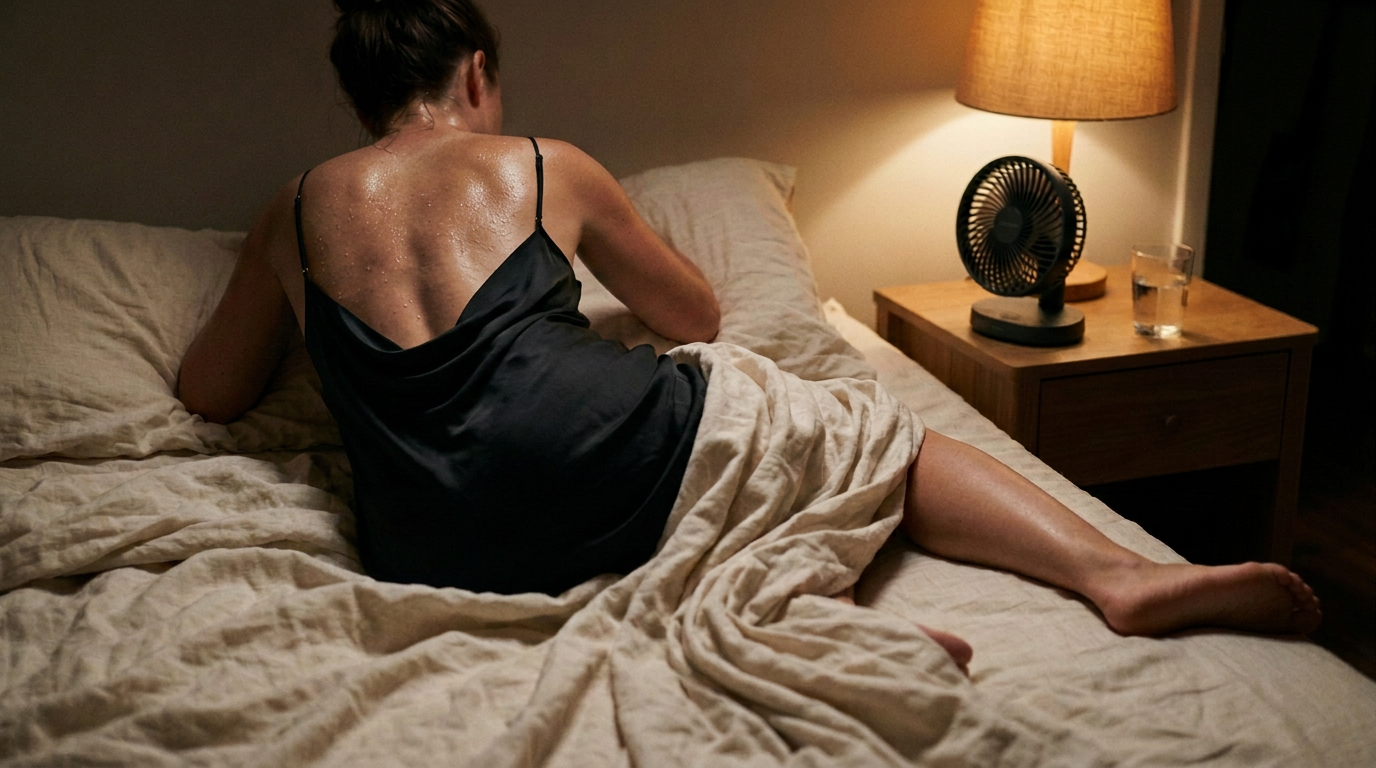
In health, the relationship between the Kidney and the Heart works like water and fire held in careful balance — Kidney Yin rises to cool the Heart, and Heart Yang descends to warm the Kidney, each keeping the other from excess. When Kidney Yin depletes, that cooling water is no longer available, and the Heart fire burns like a forest whose lake has dried up — unchecked, spreading upward, with nothing left to bring it down.
The body expresses this as night sweats and heat in the palms and soles of the feet, a racing heart in the quiet of the night, and a restlessness that makes it impossible to find a comfortable position regardless of how tired you feel. The mind does not race with thoughts as much as a low agitated heat in overthinking. It is the sense of being too warm inside, even when the room is cool.
This pattern is not exclusive to any particular life stage, but it is especially common during perimenopause and menopause, when Kidney Yin naturally begins to decline.
Essential oil blend
Clary sage 1 drop · Neroli 1 drop · Geranium 1 drop · Sandalwood 1 drop · In a 1% dilution
Clary sage regulates hormonal activity and is deeply cooling. It sweeps away the internal heat that causes the restlessness and tossing. Neroli has a particular affinity for the Heart. When Heart fire flares, neroli cools it and anchors the Shen with a gentleness. Geranium rebuilds fluid and gently moves Qi, ensuring that as Yin is replenished, energy circulates rather than stagnates. Sandalwood enters both the Kidney and Heart meridians simultaneously — it is the anchor of this blend, pulling energy downward to the lower abdomen and locking the Shen into rest for the night.
Carrier oil
Evening primrose oil 70% · Hemp seed oil 30% · Total 13ml
Evening primrose is cool, dense, and deeply moistening — it mimics the physical substance of the Yin fluids that are missing, stabilising erratic energy and clearing the heat behind hot flushes and night sweats. Hemp seed oil is a Yin tonic that builds the Kidney's foundational reserve, addressing the depletion at its source.
How to apply
Warm a few drops in the palms and rub the chest in slow clockwise circles to release tightness and calm the Heart.
Massage the abdomen in the same direction, then apply firm strokes along both sides of the lower back, where the Kidney meridian runs alongside the spine.
Apply 1 drop to San Yin Jiao — 三陰交 (sān yīn jiāo) — four finger-widths above the inner ankle bone, just behind the shinbone. For Kidney Yin deficiency specifically, this point nourishes all three leg Yin meridians simultaneously and is the most efficient single point for rebuilding what has been depleted.
Finally, warm a few drops in the palms and massage the soles of the feet. Press into Kidney 1 — 湧泉 (yǒng quán) — to draw the heat from the head downward and root the energy in the lower body where it belongs.
Pattern 3 — 肝陽上亢 — Hyperactivity of Liver Yang
Prolonged Yin deficiency causing Liver Yang to rise unchecked

Liver Yang rising in this pattern behaves like pressure building in a sealed container with no valve — when Kidney Yin has been depleted long enough that it can no longer push back against the rising energy, Liver Yang forces its way upward with nothing to restrain it. Anger, agitation, and prolonged stress that have accumulated in the Liver now have free passage, generating internal heat that drives directly into the mind.
The symptoms are hard to miss: falling asleep feels almost impossible, the ears ring in the silence, dreams are excessive and disturbing, and waking up with anger. Headaches sit at the temples, the eyes strain easily, and the nervous system feels perpetually wound too tight.
Essential oil blend
German chamomile 1 drop · Lavender 1 drop · Frankincense 1 drop · In a 1% dilution
German chamomile is rich in chamazulene, a compound that is energetically cold and profoundly anti-inflammatory. It acts like cold water thrown onto the raging Liver fire, relieving the physical tension, headaches, and eye strain caused by rising Yang and cooling an angry nervous system almost immediately. Lavender is the harmoniser of this blend. It smooths Qi and clears heat, gently untying the knots where friction and stagnation sit, and carries calm into the Heart meridian before the Liver's heat can disturb the Shen further. While German chamomile and lavender cool and smooth the upper body, frankincense acts as the anchor — grabbing the rising energy and drawing it steadily downward, restoring the directional flow that this pattern has disrupted.
Carrier oil
Evening primrose oil · 10ml
Evening primrose is cool and moistening — it generates Liver Yin to hold Liver Yang in check, providing the rich, cool fluid the body needs to tether its own rising energy.
How to apply
Apply 1 drop of the blend to Liver 3 — 太衝 (tài chōng) — in the depression between the first and second toe on the top of the foot. Massage with deep, firm strokes. This is the master point for draining excess Liver Yang.
Massage the temples gently in small circular movements, and stroke downward along both sides of the neck following the direction of the Gallbladder meridian to relieve the headache, tension, and agitation that rising Yang accumulates in the upper body.
Finally, massage the soles of the feet with the remaining blend, pressing into Kidney 1 — 湧泉 (yǒng quán) — to draw energy downward and reinforce the grounding that frankincense has begun.
Pattern 4 — 肝氣鬱結 — Liver Qi Stagnation
Emotional suppression blocking the smooth flow of Liver Qi

The Liver governs the smooth, even flow of Qi and emotion throughout the body. When emotional suppression builds, it fills that channel the way mud and debris fill a riverbank, until the water stops moving. Depression, frustration, and the particular exhaustion of feelings block the Liver Qi, preventing the natural downward movement of energy that sleep requires.
The pattern this creates is recognisable: difficulty falling asleep between one and three in the morning — the Liver's peak hours, accompanied by a tightness in the chest. During the day there is a tendency to sigh frequently, the digestion is sensitive and worsens with stress.
Essential oil blend
Bergamot 1 drop · Lavender 1 drop · Vetiver 1 drop · In a 1% dilution
Bergamot is the dispeller. It breaks up the emotional compression held in the Liver and Spleen, untying the tight chest or anxious stomach that daily stress creates. It is one of the most effective oils in the toolkit for moving Liver Qi without overstimulating, making it appropriate for use close to sleep. Lavender smooths the Qi so that as it releases, it circulates evenly rather than creating turbulence, and carries the energy peacefully toward the Heart. Vetiver is the anchor pulling the newly freed Qi downward before it can float up into wakefulness again.
Carrier oil
Sweet almond oil · 10ml
Sweet almond oil nourishes the Spleen and Stomach — the organ systems most often affected downstream when Liver Qi stagnation disrupts the smooth flow of energy through the digestive tract.
How to apply
Apply 1 drop of the blend to Liver 3 — 太衝 (tài chōng) — in the depression between the first and second toe on the top of the foot. Massage with deep, firm strokes to release the valve and begin the downward movement of stuck Liver Qi.
The Liver meridian wraps tightly around the lower ribcage. Massage the blend along the sides of the ribcage and below the sternum with slow, upward-then-outward strokes — this is where the physical tightness of Liver Qi stagnation is most often held in the body.
Finally, massage the soles of the feet with the remaining blend, allowing the vetiver's grounding quality to settle the released energy.
Pattern 5 — 胃氣不和 — Stomach Qi Disharmony
Food stagnation generating damp-heat that disturbs the Shen

When food stagnates in the Stomach, it behaves like a pot left sealed on the heat too long — pressure builds from within, generating damp-heat that has nowhere to go but upward, directly into the mind. An ancient TCM saying captures this precisely: 胃不和則臥不安 — if the Stomach is disharmonious, sleep will be restless. This pattern is often worse after late dinners, rich meals, or periods of irregular eating.
Stomach Qi disharmony reflects at night as tossing and turning in the bed, waking with a heavy head and a sense of undigested fullness that sits in the chest and stomach.
Essential oil blend
Mandarin 1 drop · Coriander 1 drop · Patchouli 1 drop · Vetiver 1 drop · In a 1% dilution
Aged tangerine peel — 陳皮 (chén pí) — is one of TCM's most valued herbs for settling a disturbed Stomach, and mandarin essential oil carries similar energetic properties. It gently activates a stalled digestive tract and draws Stomach Qi downward, lifting the pressure off the chest and mind. Coriander is warm, spicy, and sweet. It is carminative in both Western and TCM terms to dispel gas, relieve cramping, and ease the bloating. Patchouli uses its deeply aromatic and earthy character to dry the internal dampness that undigested food generates, clearing the turbidity before it can rise to disturb the Shen. Vetiver adds a sedative, anchoring quality that carries everything downward into rest.
Carrier oil
Sweet almond oil · 10ml
Sweet almond oil tonifies the Spleen and Stomach and is a gentle lubricant for the abdominal wall, easing the physical tension that accumulates in the abdomen when digestion is burdened.
How to apply
Warm a few drops in the palms and massage the upper abdomen between the sternum and the navel in slow clockwise circles. This physically stimulates peristalsis, follows the natural direction of digestion, and brings the oils into direct contact with the Stomach and Spleen meridians that run across the abdomen's surface.
Apply 1 drop to Stomach 36 — 足三里 (zú sān lǐ) — four finger-widths below the kneecap and one finger-width outside the shinbone. This is the longevity point and the most broadly tonifying point for Spleen and Stomach in the entire TCM system.
Finally, massage the soles of the feet with the remaining blend, allowing vetiver's sedative quality to settle the body fully into the rest.
Building a sleep ritual
The blends above address the root pattern. The habits below create the conditions that make those blends work.
Avoid excessive caffeine during the day and stop eating at least two hours before bed — overeating at any meal burdens the Stomach and makes the evening harder to settle.
Put away electronic devices an hour before sleep and dim the lights at the same time, giving the body a gradual signal that the day is ending.
Keep a consistent sleep hour — the body clock responds to regularity.
Exercise during the day to dispense accumulated Yang energy so it is not still circulating when you lie down.
If you find yourself tossing and turning, get up. Read something quiet or sit in meditation rather than fighting the wakefulness in bed. Lying awake reinforces the association between the bed and alertness, which is the opposite of what the body needs to learn.
A note on safety
The blends in this article are written for healthy adults experiencing functional insomnia. If you are pregnant, breastfeeding, managing a chronic condition, taking regular medication, or caring for a child or elderly person, please consult a qualified aromatherapist before beginning.