Winter Cold & Flu Prevention: Essential Oils for Immunity
Winter doesn't just bring cold air—it brings vulnerability. Protect your Lung meridian with tea tree, ravintsara, and thyme essential oils. Five practical formulations, warming diet shifts, and daily acupressure to prevent cold, flu, and respiratory weakness.

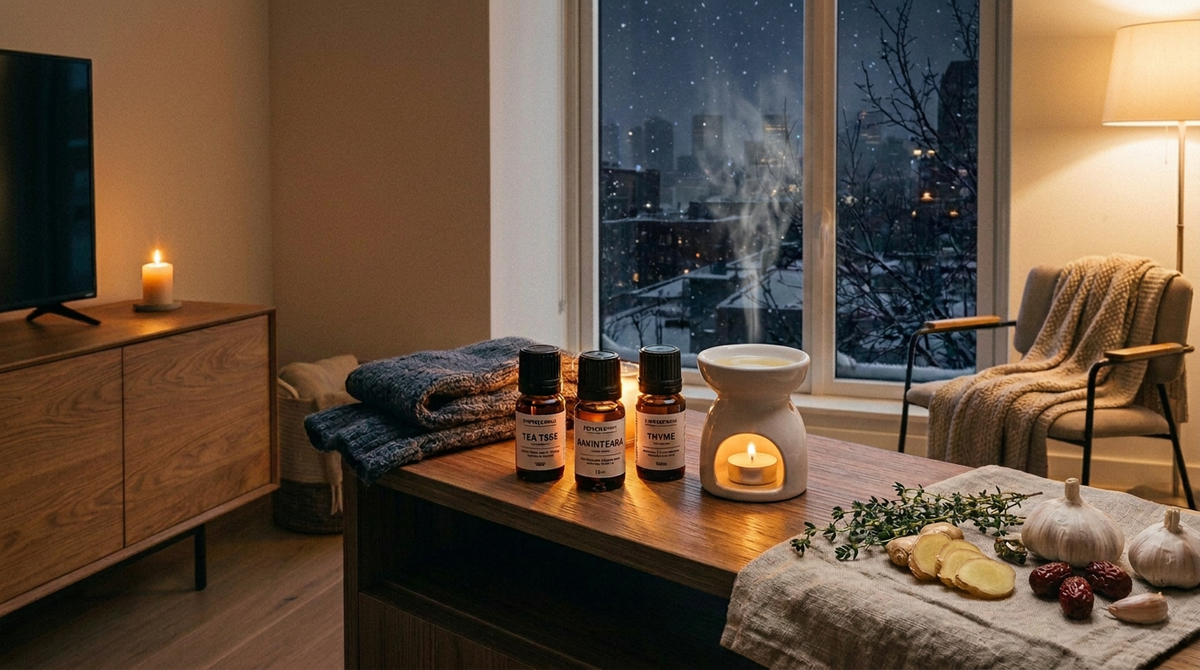
Build Your Winter Immunity Defense
Winter in TCM represents the season when your defensive Qi becomes most vulnerable. As temperature drops, the Lung meridian, which governs your boundary between self and environment, requires conscious support. This article provides five essential oil formulations, warming dietary shifts, and daily practices to prevent cold, flu, and respiratory weakness throughout the winter months. Whether you're prone to catching every virus or managing a tendency toward lingering coughs, this prevention strategy targets the root: building Lung Qi before exposure arrives.
Why Winter Weakens Your Lung Meridian
As winter arrives, the trees have shed their last leaves. Animals have retreated to wait out the cold. Even the grasses that were stubbornly pushing through the soil have finally given up and gone to rest beneath it. Nature falls silent, as though every living thing is tired after a full year of growing, blooming, and giving.
The three winter months are the season of stillness. They are also the season when we are most vulnerable to colds and flu — when the body's Defensive Qi, the energetic shield that protects us from external pathogens, is at its lowest ebb.
Defensive Qi — the equivalent of immunity in modern terms — is governed by the Lung in TCM. It flows through the skin, muscles, and outer layers of the body, forming the first line of defence against pathogens. When Defensive Qi is deficient, the early warning signs often appear on the surface: allergic skin reactions, muscle aches, and a general sense of vulnerability — followed, if the pathogen advances, by a sore throat, a runny nose, coughing, headache, fever, or bronchitis as the invasion moves deeper into the respiratory tract.
Prevention
Wear Layers to Protect Your Meridians
Where modern medicine names viruses as the agent behind a cold or flu, ancient Chinese wisdom points to Wind — 風 (fēng) — as the primary invader. Wind enters the body through the pores, the mouth, the nose, or two specific acupressure points at the back of the neck: Wind Gate — 風門穴 (fēng mén xué) — and Wind Pool — 風池穴 (fēng chí xué). The most straightforward defence is also the most overlooked: wrap up warmly and wear a scarf. It sounds basic, but not everyone follows it as consistently as they should.
In TCM, Yin and Yang are constantly moving in dynamic balance within the body, shifting with the season, the time of day, and our physical condition at any given moment. In winter, the body naturally draws its Yang energy and Defensive-Qi inward to preserve it until spring. This means our immune capacity is lower than usual, and the wisest response is to mirror what nature does: slow down, stay warm, and conserve energy.
There is one practical detail worth remembering. When you move from the cold outdoors into a heated room, your pores open to release the internal heat. If you then step back into the cold before the body has adjusted, Wind can slip in through those open pores. Covering yourself — a scarf, a coat, a hat — before going back outside is a simple act that can prevent a great deal of suffering.
Eat Warming Foods to Support Digestive Fire
Replenishing Yang energy through food is equally important in winter. TCM seasonal eating guides you toward warming and nourishing foods suited to the cold months: chicken, lamb, beef, and duck prepared with ginger, red dates, and goji berries. Black-coloured foods are specifically valued in winter for their ability to tonify the Kidney — black fungus, chestnuts, and black sesame are all traditional choices. A few classic Cantonese winter dishes capture this perfectly: braised lamb with hot pot, nourishing chicken soup, and black sesame dessert soup.
3 essential oils for winter wellness
Essential oils can be woven into your winter wellness routine to target a specific condition while offering the added pleasure of scent and the therapeutic benefit of the application itself. Three oils are particularly well suited to winter: they strengthen Defensive Qi, suppress pathogens in the environment, and address the most common respiratory complaints of the season.
Tea tree (Melaleuca alternifolia)— The Acute Response Oil
Tea tree can be used safely across a wide range of bacterial, viral, and fungal infections — working like a natural antibiotic while simultaneously supporting the body's own immune response rather than suppressing it. It strengthens Defensive Qi and is particularly indicated for the colds, flu, and bronchitis that are most common in winter. Its cooling and pungent nature helps disperse the thick, yellowish phlegm that develops when clear phlegm is transformed by internal or external heat. It also tonifies Qi in cases of chronic lethargy, shallow breathing, a racing heart, and poor circulation — making it well suited to those who feel physically stagnant and low during the cold months.
Ravintsara (Cinnamomum camphora ct. cineole)— The Lung Tonifier
Ravintsara earns its place in winter practice through its powerful ability to tonify Qi. It has a particular affinity for the Lung and Large Intestine meridians, which govern the body's boundary with the external environment and regulate respiration. Its warming and pungent character supports an upward and outward movement of energy — circulating Qi to the skin's surface, opening the pores, and actively expelling external cold pathogens before they can settle deeper into the respiratory system. It relieves chills, clears nasal discharge, and eases body aches. It also strengthens Defensive Qi as an energetic shield against seasonal viral infection. Its dispersing quality unblocks stagnant Lung energy — the kind that constricts the chest, causes congestion, and produces a persistent cough — facilitating clearer breathing and helping to shift phlegm from the airways.
Thyme ct. Thymol (Thymus vulgaris ct. thymol)— The Deep Warmer
Thyme thymol is a highly warming and penetrating oil. It has an affinity for the Lung, Spleen, and Stomach meridians and drives energy downward to consolidate and anchor it. It is suited to people who feel cold from the inside, who have a deep, rattling cough with clear phlegm, or who feel physically exhausted with a weakened digestive system. Where tea tree and ravintsara open the nasal airways and dissolve chest blockages, thyme thymol works differently — draining and drying up cold, damp mucus at its source.
| Essential Oil | Active Ingredients | Action | Best For |
|---|---|---|---|
| Tea Tree | Terpineol + cineole | Mobilizes immune response; kills pathogens | Acute exposure prevention |
| Ravintsara | Limonene + sabinene | Tonifies Lung Qi; disperses cold pathogens | Building defensive barriers |
| Thyme ct. Thymol | Thymol + carvacrol | Warms internal cold; supports rattling coughs | Chronic cold constitution |
Five Formulations for Winter Immunity
For Daily Prevention
To purify a room, diffuse tea tree 3 drops, lemon 1 drop, and eucalyptus 1 drop in a burner or atomising diffuser for 30 minutes with a window open.
For Immunity
To strengthen immunity, add ravintsara 3 drops, tea tree 2 drops, and lemon 2 drops to a tablespoon of honey, milk, or liquid soap, then pour into a warm bath. Soak for 15 to 20 minutes.
For Lingering Coughs
To treat a cough with clear phlegm. dilute ravintsara 2 drops and thyme thymol 1 drop in 10ml of sweet almond oil. Apply to the throat and chest.
For Acute Exposure Response
To treat a cough with thick, yellowish phlegm, dilute tea tree 2 drops, eucalyptus 2 drops, and lemon 1 drop in 10ml of sweet almond oil. Apply to the throat and chest.
For Breathing Relief
To relieve a blocked nose, add lemon 2 drops, rosemary 1 drop, and tea tree 1 drop to a facial steamer or bowl of just-boiled water. Lean over and inhale the steam slowly through the nasal passage.
Safety & When to Seek Care
Essential oils are preventative and supportive, not replacements for medical care. These formulations are written for healthy adults managing seasonal cold and flu risk. The practices below are designed to strengthen your immune foundation before illness arrives, not to treat serious respiratory infection.
Who Should Consult a Qualified Aromatherapist First
If you are pregnant, breastfeeding, managing asthma or chronic obstructive pulmonary disease (COPD), taking immunosuppressant medications, or caring for infants, young children, or elderly household members, please consult a qualified aromatherapist (mIFPA certified) before using these formulations. Some essential oils can interact with medications or pass into breast milk; professional guidance ensures safety for your specific situation.
Dilution Is Non-Negotiable
All essential oils in this article are diluted before skin application or used only in diffusion/steam. Always use the drop counts and carrier oil ratios specified. When in doubt, dilute more, not less.
When to Stop Self-Care and Seek Medical Attention
Contact your doctor immediately if you experience:
- High fever (above 38.5°C / 101°F) lasting more than 3 days — may indicate bacterial infection or flu requiring antiviral treatment
- Shortness of breath or chest pain — possible pneumonia or cardiac involvement
- Cough producing blood or discolored phlegm — suggests bacterial secondary infection
- Severe fatigue or confusion — signs of systemic infection severity
- Symptoms worsening after 7–10 days — typical viral cold should improve by day 7; worsening suggests complication
- Wheezing or difficulty breathing — airway narrowing requires medical evaluation
These essential oil practices are excellent for preventing illness or supporting mild, early-stage symptoms. Once infection has progressed to respiratory distress, fever, or secondary bacterial infection, medical intervention becomes necessary.