Eat what the season grows — a summer guide to the nourishing kitchen
Your grandmother followed the same rules without knowing their name. A guide to TCM's Four Natures and Five Flavours — and the summer kitchen your body has been asking for all along.
The body already knows
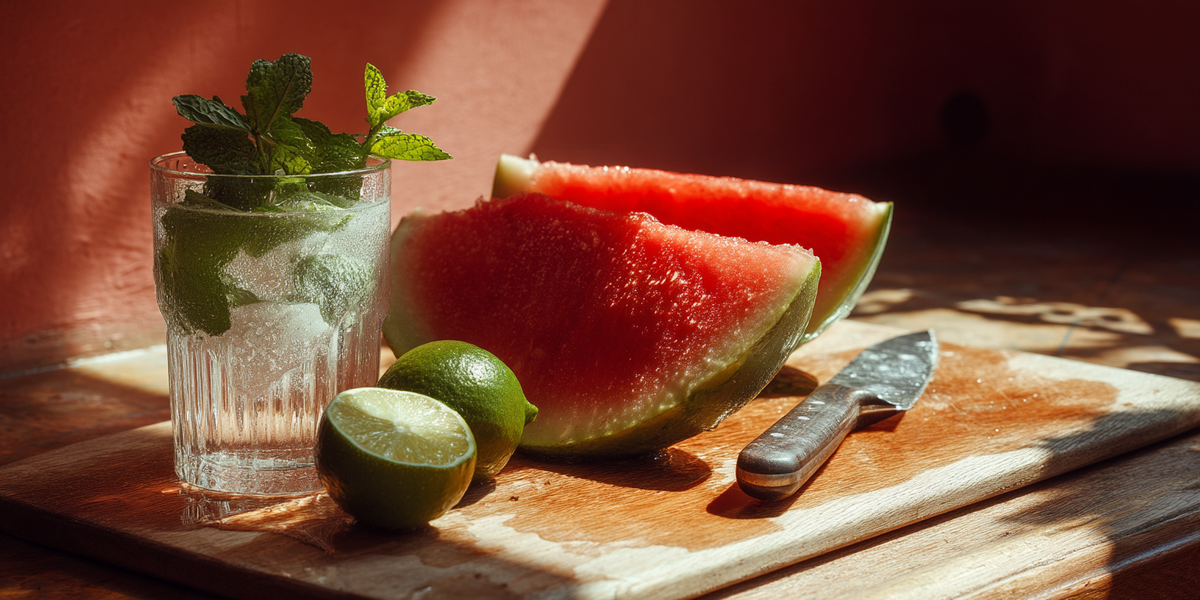
In the summer heat, when humidity rises from the pavements and the air itself seems to steam, I find myself wanting a glass of watermelon juice. Or a mojito, if the vibe calls for it. I also want to stop at a gelato shop and order at least two scoops, enough to keep the cooling sensation in my mouth all the way to wherever I am going.
If you have felt this too, it is not a lack of self-control. It is your body responding to what the season demands. The ancient understanding that the human body and the natural order are inseparable. You did not need TCM to tell you what to want. The body already knew.
TCM simply explains why and gives us the tools to respond with a little more intention.
Four natures, five flavours
In TCM, food from nature is understood through two dimensions: the Four Natures and the Five Flavours. The Four Natures (四氣) — cold, cool, warm, hot — describe a food's effect on the body's temperature. The Five Flavours (五味)— sour, bitter, salty, pungent, sweet — describe which organs a food nourishes and how it moves energy within the body.
Think of it like a wine specialist who can trace how a taste evolves across the tongue — first fruit, then earth, then a long finish that arrives somewhere unexpected. With attention, we can learn to feel the same thing with food: how sweetness gathers and settles, how bitterness clears, how pungency rises. The body is always giving this information. TCM gives us the language to understand it.
What summer asks you to eat
Watermelon is cold in nature and sweet in flavour. In TCM, sweetness nourishes the spleen and stomach, the organs responsible for producing and distributing fluid throughout the body. Its coldness dissolves internal heat immediately. This is why watermelon cools, hydrates, and supports the body's natural elimination.
The mint leaves in a mojito play a different role. Mint is cooling and pungent. When you chew mint-flavoured gum, the cooling sensation travels up through the tongue and sometimes reaches the sinuses, making you sneeze. In TCM, the pungent flavour carries energy upward, and mint takes that quality to its extreme. It does not simply cool the body as watermelon does. It actively disperses heat outward and upward, opening the channels through which the season's excess can leave.
Two ingredients in one glass working together — one dissolving the heat from within, one dispersing it from without.
What my mother knew without studying TCM
I grew up in Hong Kong, where eating according to the season was simply what families did. We had stir-fried bitter melon with black soybean marinated fish (苦瓜炒豆豉鯪魚), old cucumber soup with azuki beans and lentils (黃瓜赤小豆扁豆湯), and stuffed winter melon soup (冬瓜盅). These recipes passed from one generation to the next without anyone citing a medical framework. My mother used to say: eat melons in summer, vegetables in winter.
She had not studied TCM formally. Neither had her mother. But they were paying attention to what grew in each season, to what the body asked for, to what had always worked. This is perhaps the most important thing the Five Flavours framework teaches: not a set of rules to memorise, but a direction of attention. The wisdom was always available. TCM simply wrote it down.
Eating the season in Europe
Living in Switzerland, some of the traditional ingredients are not easy to find. I have learned to adapt. Old cucumber, which carries sweetness to nourish the spleen and is deeply hydrating, can be replaced with honeydew melon in the soup - the same energetic quality in a different name. I make a summer gazpacho by blending watermelon, tomatoes, bell pepper, basil, and peppermint together. The sweet and sour flavour acts as a digestive aid, supporting the stomach through the heaviness that summer heat can bring.
And the gelato. I have made my peace with one scoop instead of two. Ice helps cool the body temperature immediately, and I understand the impulse completely. But in TCM, excessive cold damages the spleen and stomach over time, impairing the very organs responsible for fluid distribution and digestion. One scoop is an act of joy. Two scoops, on the hottest days, is borrowing against tomorrow.
The rule your body already follows
You do not need to memorise the Four Natures or the Five Flavours. You do not need to follow any specific recipes. The body has been following the season's logic long before either of us had words for it.
Learn from nature. Listen to your body. Follow the flow.